You announce a new habit to a friend. They say they will keep you honest. For ten days the two of you trade messages about it. Then the messages thin out, the replies get vague, and one day neither of you mentions it again. The habit dies, and nobody quite knows when.
The partner was not the problem. The partnership had nothing concrete to stand on. It ran on good intentions and warm feelings, and those fade fast. What survives is a shared record, a fixed appointment, and a number both people can see. That is where your habit tracker Excel template earns its place.
In this guide you will learn why accountability works when it is built correctly, how to share your tracker without handing over your privacy, the exact 15 minute weekly check-in that keeps a partnership alive, and the mistakes that turn a helpful partner into one more thing you avoid.
Why Accountability Actually Works
Accountability is not about being scolded. It is about changing what happens in the moment before you decide to skip.
When a habit lives only in your head, skipping it costs you nothing right now. The cost arrives weeks later as a vague sense of disappointment, and by then the decision is long gone. A partner collapses that timeline. The skip becomes visible within days, and visibility is what your brain responds to.
Three things make the difference:
- A specific expectation. "I will walk 20 minutes after lunch, five days a week" is an agreement. "I am trying to move more" is a mood. Only the first one can be kept or broken, so only the first one creates accountability.
- A witness who checks. Research on goal pursuit has repeatedly found that people follow through more when someone is expecting a report. The expectation does most of the work, long before the conversation happens.
- A visible record. Memory is generous with excuses. A row of empty boxes is not. Your tracker replaces the story you tell yourself with the pattern that actually happened.
Notice what is missing: pressure, guilt, and nagging. Those produce short term compliance and long term avoidance. The goal is a light, predictable touch that makes showing up easier than explaining why you did not.
Why Most Accountability Partnerships Fall Apart
Most partnerships fail for boring structural reasons, not because either person is unreliable.
The check-ins are vague. "How is the habit going?" invites "pretty good" and the conversation ends. There is no data, no pattern, and no adjustment. After three weeks it feels pointless, because it is.
There are too many habits. A partner cannot meaningfully follow eight daily goals. Attention splits, the check-in becomes a checklist reading, and both people disengage. Three habits is plenty, and two is often better.
It runs on feelings instead of facts. Reporting that you "felt productive" tells your partner nothing. Reporting six out of seven days tells them exactly where to look.
One person carries the whole thing. If the partner never shares anything back, the relationship becomes an obligation. Reciprocity is what keeps it alive for months instead of weeks.
Shame creeps in. The moment a missed week turns into a lecture, the person being coached starts hiding the data. Hidden data kills the entire point of tracking.
Set Up the Shared Tracker in 5 Steps
You can build the whole arrangement in an afternoon. Here is the sequence that works.
Step 1: Choose a partner for consistency, not comfort
The best partner is not your biggest cheerleader. It is someone who is steady, direct, and mildly curious about your progress. A close friend who accepts every excuse is worse than a coworker who asks one honest question each Friday.
Pick someone who keeps their own commitments, because their example does half the work. If you can find someone working on a habit of their own, even better. Mutual reporting outperforms one way reporting every time.
Step 2: Write three habits as yes or no actions
Open your habit tracker Excel template and list no more than three habits. Each one needs to be answerable with a checkbox, not a paragraph. "Read one page" works. "Read more" does not.
Three is the ceiling because your partner needs to hold the whole picture in their head. If you want to work on five things, pick the three that matter most this month and rotate the others in later. A narrow focus also makes the data easier to read, which keeps the check-in short.
Step 3: Share read only access
If you use Google Sheets, share the file with view or comment access. Your partner should be able to see the grid and leave a note, but not tick your boxes. Ownership matters: the habit has to remain yours.
If you use Excel, share through OneDrive or Google Drive with the same permission, or send a screenshot before each check-in. A screenshot is perfectly fine. The value comes from the numbers being real, not from live syncing.
Only share the habit tab, not your whole life. A tracker with a weekly summary row gives your partner everything they need: completion percentage per habit, current streak, and one notes column. That is enough context to have a useful conversation.
Step 4: Book a fixed 15 minute check-in
Put it on both calendars and treat it like a dentist appointment. Same day, same time, every week. Friday afternoon or Sunday evening both work well, because they sit close to the week you are reviewing and the week you are about to plan.
Fifteen minutes is deliberate. Long enough to review three habits properly, short enough that neither of you dreads it. If you skip a week, do not double the next one. Just resume on schedule. A partnership that survives busy weeks is worth more than one that runs perfectly for a month.
Step 5: Agree on the miss rule in advance
Decide now what happens after a missed day, while nobody is embarrassed. The simplest rule is the one that works for streaks: never miss twice. One empty box is a data point. Two in a row is a pattern, and the check-in exists to interrupt it.
Write the rule in the notes column so there is no negotiation later. Something like: "A miss is information, not a failure. We look for the cause and adjust one thing." That single sentence prevents most of the shame spirals that end partnerships.
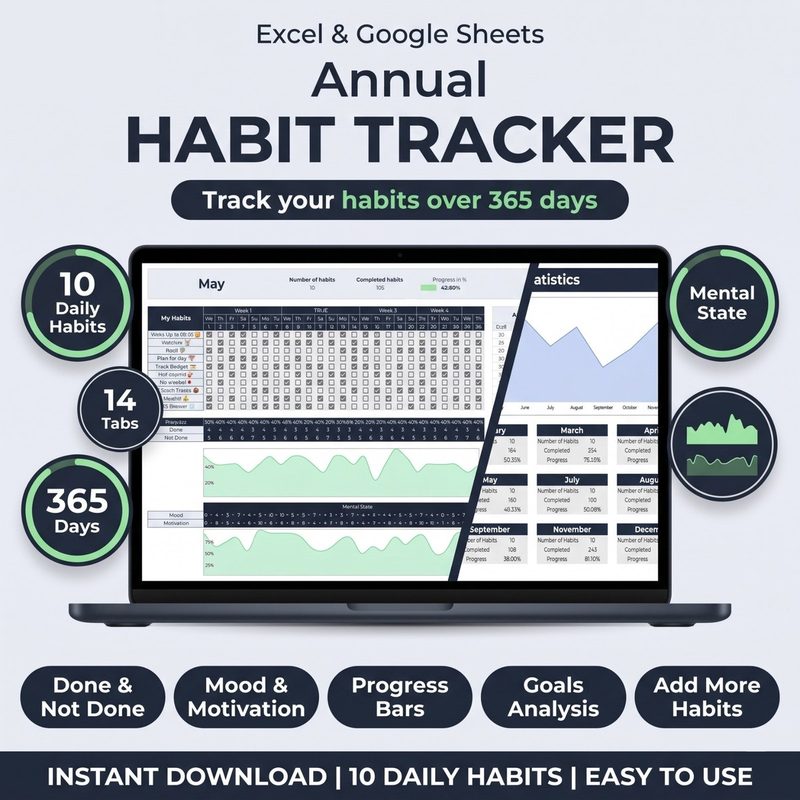
Give the conversation something real to look at. The Habit Tracker for Excel & Google Sheets includes a monthly grid, streak counts, and a weekly summary that is easy to share with a partner.
Get the Habit Tracker · $10The 15 Minute Weekly Check-In Script
A good check-in has a shape. Without one, it drifts into catching up about life and the habit never gets discussed. Follow this outline and the conversation stays useful without feeling clinical.
- Minutes 1 to 3: Read the numbers out loud. Go habit by habit. "Walked four of seven days. Read six of seven. No sugar four of seven." No commentary yet. Just the facts.
- Minutes 4 to 7: Name the obstacle. For each miss, ask one question: "What was happening when you skipped?" Look for a cause you can change, such as a late meeting, a missing cue, or a plan that was too ambitious. Avoid character judgments. "I was tired" is a circumstance. "I am lazy" is a story.
- Minutes 8 to 12: Choose one adjustment. One. Not a whole new plan. Maybe the walk moves to the morning, or the reading target drops from a chapter to a page. Update the tracker notes so the change is recorded.
- Minutes 13 to 15: State next week's commitment. Each person says the specific number they are aiming for. Your partner writes it down or you log it in the tracker. Close with something genuine about effort you noticed, not just results.
Fifteen minutes, every week, in that order. It sounds almost too simple to matter. Do it for two months and you will notice that you start thinking about Friday during the week, which is exactly when accountability does its work.
"Accountability is not someone standing over you. It is someone expecting you, at a time you both agreed on, with numbers you both trust."
: My Habit Journals
How to Be a Good Accountability Partner
If you are on the other side of the arrangement, your job is smaller and more delicate than it looks.
Ask, do not advise. Questions like "what made that day different?" produce more change than instructions ever will. Advice puts you in charge of their habit, which is the fastest way to make them stop caring about it.
Praise the process. "You showed up on a hard week" is more useful than "great job on the streak." The first one reinforces the behavior that creates streaks. The second one only celebrates the streak itself, which makes a broken chain feel like a lost identity.
Hold the agreement, not the person. If they promised four days and did two, say so plainly and without heat. "We said four, you logged two. What do you want to change?" That is the whole conversation.
Keep it short and predictable. Reliability beats intensity. A partner who shows up every Friday for six months is worth more than one who sends three motivational paragraphs and then disappears.
Track the Partnership Itself
Here is a small addition that keeps the arrangement honest: add a check-in row to your habit tracker Excel template. One checkbox per week for "check-in completed."
It takes ten seconds and turns the partnership into a tracked habit of its own. You will quickly see whether the meetings are actually happening or whether you have been telling yourself they are. A monthly glance at that row is enough to catch a partnership that is quietly fading, which is the most common way these arrangements end.
If you also track a monthly review, fold the partnership into it. Two questions are enough: did we meet every week, and did my numbers improve? If the answer to the first is yes and the second is no, the problem is the plan, not the accountability. That is a useful distinction, and you can only see it with a record.
Four Ways to Structure the Partnership
One to one with a friend. The classic version. Best when both people have their own habits to report, so the conversation stays balanced. Share one file with a tab for each person.
With a partner or spouse. Powerful, but only if you separate the check-in from ordinary household conversation. Put it on the calendar and keep it to fifteen minutes. Otherwise every dinner becomes a vague progress audit.
With a coworker. Surprisingly effective for work adjacent habits such as focus blocks, study, or an early start. The relationship is already structured around a schedule, which makes the weekly slot easy to keep.
A group of three. A small group is more resilient than a pair, because if one person is traveling or busy, the other two still meet. Keep the group at three or four. Beyond that, the check-in turns into a meeting and the personal detail disappears.
Common Mistakes to Avoid
Checking in daily. Daily messages feel supportive for a week and then become noise. Weekly is enough to catch a slide, and it respects the fact that habits fluctuate day to day. If you want a daily nudge, use your tracker, not your partner.
Reporting only the wins. A check-in where every box is full is either a perfect week or a dishonest one. If your partner never sees a miss, they cannot help you fix anything. Bring the real grid.
Letting the partner set the goal. Your partner can question a target, but they should not choose it. Ownership is what makes a habit survive after the novelty of the partnership wears off.
Turning the check-in into therapy. Fifteen minutes is not enough for everything going on in your life, and trying to fit it all in crowds out the habits. Talk about the week, then talk about the plan. Save the rest for a proper conversation.
Punishing a miss. The moment a missed week costs you your partner's approval, you will start avoiding the check-in. Avoidance is the one outcome that makes the whole arrangement worthless.
Frequently Asked Questions
Do I have to share my entire habit tracker?
No. Share only the tab with the three habits you agreed to review, or send a screenshot of the weekly summary. Your partner needs the relevant numbers, not your whole journal. Keeping the share narrow makes you more willing to be honest.
What if my accountability partner is less consistent than I am?
Say it once, directly, and offer a smaller commitment. "Can we do a five minute message every Friday instead of a call?" A lighter arrangement that happens beats an ambitious one that does not. If they still cannot show up, find a second partner for the habits that matter most.
How often should accountability partners check in?
Once a week for most habits. Weekly is frequent enough to catch a two day slide and rare enough to stay sustainable. Daily check-ins are usually too much, and monthly is too late to change anything.
Can this work with Excel if we do not use cloud sharing?
Yes. Export a PDF or take a screenshot before each check-in and send it over. The format does not matter. What matters is that the numbers are current and that you both look at the same record at the same time.
What should we do if we miss a check-in?
Resume the following week without doubling up. Add the check-in itself as a row in your tracker so you can see how often it happens. A partnership that bends through a busy month is more valuable than one that shatters the first time life interferes.
The Bottom Line
Accountability is not a personality trait and it is not a punishment. It is a structure: a small number of specific habits, a shared record, a fixed fifteen minutes, and a partner who asks honest questions without judging the answer.
Your habit tracker Excel template is the piece most people skip, and it is the piece that makes the rest work. Without it, the check-in becomes a feelings exchange. With it, the conversation starts from facts and ends with one clear adjustment.
Pick one person this week. Choose three habits. Share the grid. Put fifteen minutes on the calendar for Friday. Then let the record do what willpower could not, one honest week at a time.