It happens to everyone. You have been tracking consistently for weeks. The green checkboxes fill your habit tracker Excel template like a chain of victories. You feel unstoppable. Then one day you skip. No big deal, you tell yourself. But that one day turns into two, then three, and before you know it, the chain is broken and you have not tracked anything in a week.
The broken streak is the single most common reason people abandon habit tracking. The all-or-nothing mindset kicks in: "I already ruined my streak, so what is the point?" This mental trap is responsible for more abandoned trackers than any lack of motivation or willpower ever could be.
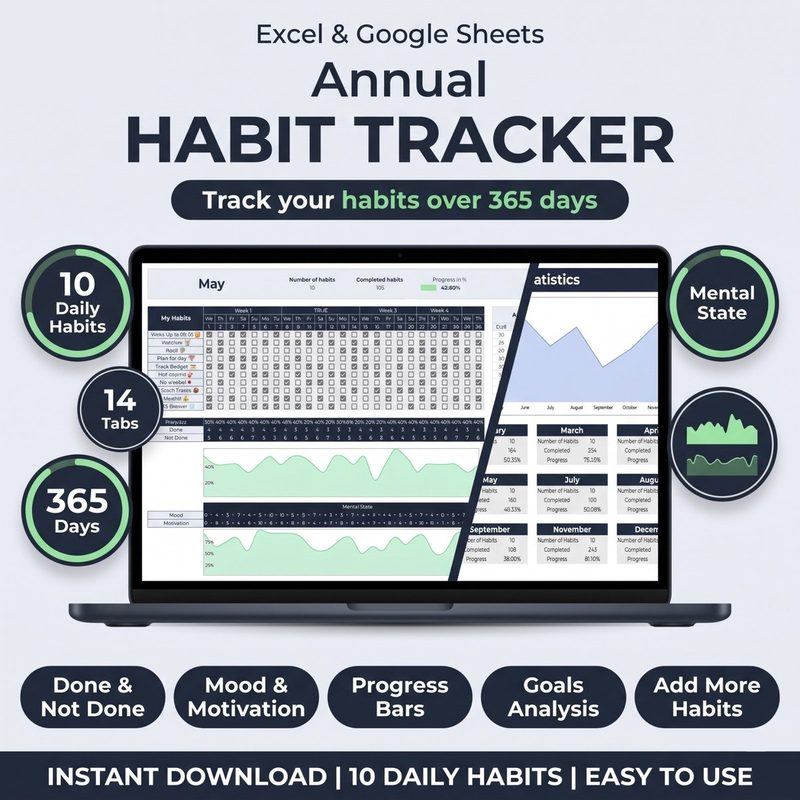
In this article, you will learn why broken streaks hit so hard psychologically, how to use the 2-day rule to prevent full derailment, and exactly how to bounce back using your habit tracker for Excel and Google Sheets. By the end, you will see that a broken streak is not the end of your habit journey. It is one of the most valuable data points you will ever collect.
Why a Broken Streak Hurts So Much (The Psychology)
Streaks are powerful because they tap into a deep psychological principle called loss aversion. Research in behavioral economics shows that losing something hurts roughly twice as much as gaining something of equal value feels good. When you break a 30-day streak, the loss feels enormous. The 30 green checkboxes you earned feel erased, even though they still represent 30 days of successful habit execution.
This is compounded by the "what-the-hell effect." Studies on dieting and self-regulation found that people who slip once often abandon their entire goal. The reasoning goes: "I already broke my diet by eating one cookie, so I might as well eat the whole box." The same logic applies to habits. Miss one workout, and the brain whispers that the whole week is ruined anyway.
But here is the critical insight that changes everything: your streak counter is a tool, not a verdict. The purpose of tracking is not to maintain a perfect chain. The purpose is to gather data that helps you improve. A broken streak is not a judgment on your character. It is a signal that something in your approach needs adjusting.
"The streak is not the goal. The goal is the habit. The streak is just a measurement. When the measurement breaks, adjust, don't abandon."
: My Habit Journals
The 2-Day Rule: Never Miss Twice
The most effective strategy for handling broken streaks comes from James Clear, author of Atomic Habits. It is called the 2-Day Rule: you are allowed to miss one day, but never two in a row.
This rule is powerful because it acknowledges reality. Life happens. You get sick. You travel. You have an emergency. Your willpower runs out. A single missed day is not a catastrophe. It is normal. The danger is not day one of missing. It is day two. Because day two turns a slip into a slide, and a slide into a full relapse.
When you follow the 2-day rule, your habit tracker Excel template becomes your safeguard. If you miss Tuesday's workout, Wednesday is non-negotiable. The checkbox for Wednesday carries extra weight because it is not just tracking a habit. It is preventing a downward spiral. Here is how to implement it:
- Define "missed" clearly. Some habits need daily execution (meditation, flossing). Others can be done 4-5 times a week (workouts, journaling). Set your minimum threshold and track against it.
- Use conditional formatting in your tracker. Highlight cells that represent day-two misses in a warning color. Visual cues in your habit tracker Excel template make the rule harder to ignore.
- Track the rule itself. Add a habit called "2-Day Rule" that you check off whenever you prevent a second consecutive miss. This turns streak protection into its own tracked habit.
Never miss twice. The Habit Tracker for Excel & Google Sheets lets you track daily habits with automatic streak counting and monthly overviews. Add the 2-day rule as a tracked habit and protect your progress from day-two derailment.
Get the Habit Tracker · $10The Recovery Protocol: 5 Steps to Bounce Back
When you do break a longer streak, the recovery process is straightforward. Follow these five steps to turn the setback into a setup for a stronger run.
Step 1: Log the Miss (Do Not Hide from It)
The first instinct after breaking a streak is to avoid looking at your tracker. You feel ashamed. You think about starting fresh next Monday or next month instead. This is exactly the wrong move. Open your habit tracker Excel template and log the miss honestly. An empty cell that represents a missed day is not an enemy. It is information. Write a short note about why you missed: "worked late," "felt sick," "traveling." Context turns data into insight.
Step 2: Reset Your Streak Counter Without Resetting Your Progress
Your habit tracker may show your current streak dropping to zero. That is fine. But your total days tracked this month, your completion percentage, and your week-over-week trends are still intact. Look at the bigger picture. A 30-day streak with one miss is still a 97% completion rate. That is not failure. That is excellence with a single data point for improvement. Do not let the streak counter overshadow the overall trend.
Step 3: Identify the Trigger
Every missed day has a root cause. It might be external (a late meeting, a sick child) or internal (low energy, decision fatigue, lack of motivation). Categorize the miss and look for patterns across your tracking history. If you notice you always miss workouts on Thursdays, that is not a character flaw. It is a scheduling problem. Your habit tracker Excel template has the data to reveal these patterns if you review it honestly. Adjust the timing, not the habit.
Step 4: Start with a Small Win
The day after a miss, do not try to compensate by doing extra. That is the ego talking, and it leads to burnout. Instead, do the minimum viable version of your habit. If you usually run 5 kilometers, run for 10 minutes. If you usually journal for 15 minutes, write three sentences. The goal is to get the checkbox, not to set a personal record. Momentum is rebuilt through action, not intensity. Once the checkbox is filled, the streak is alive again.
Step 5: Review and Adjust Your Tracking Setup
If you have broken the same streak multiple times, your tracker setup may need an adjustment. Are you tracking too many habits at once? Are your habit definitions too ambitious? Use the insights from your broken streak to refine what you track. Sometimes dropping a low-priority habit frees up the mental energy to maintain the important ones. Your habit tracker for Excel and Google Sheets is flexible enough to adapt. Add, remove, or resize habits each month based on what the data tells you.
Rethinking the Streak: Alternatives to Perfect Chains
The traditional streak counter is binary: you either did it or you did not. This works well for simple yes/no habits, but it can be demoralizing for complex behaviors where partial progress matters. Consider these alternative tracking methods that reduce the sting of broken streaks while keeping you honest.
Weekly completion percentage. Instead of obsessing over consecutive days, track what percentage of your weekly target you hit. If your goal is four workouts per week and you do three, that is 75%. Not zero. Your habit tracker Excel template can calculate this automatically. The weekly view smooths out the daily noise and gives you a more accurate picture of your consistency.
The "scorecard" approach. Instead of one streak, track multiple metrics. Number of days tracked this month. Longest streak this year. Average completion rate. Recovery rate after misses (how quickly you bounce back). When your current streak breaks, you can still win on recovery rate or monthly consistency. This prevents the all-or-nothing crash.
Cycle-based tracking. Some habits naturally follow cycles rather than daily cadences. Strength training, creative work, and deep work often follow a pattern of effort, rest, effort. Instead of a daily streak, track "sessions per week" or "hours per week." This approach is more forgiving and often more realistic for complex habits.
How to Set Up Your Habit Tracker for Streak Recovery
Your habit tracker Excel template can be configured to support streak recovery in several practical ways. Here are specific setup tips:
- Add a "Notes" column. Next to each daily checkbox, leave a small notes cell where you can jot down why you missed. Over a month, these notes become a goldmine of pattern recognition.
- Track a "Recovery" column. Add a dedicated habit called "Bounced Back" or "Recovered." Check it on days when you execute a habit after having missed the previous day. This trains you to see recovery as a separate, trackable skill.
- Use the monthly dashboard. At the end of each month, review your completion percentages rather than your longest streak. The dashboard view in your tracker shows trends over time, which is far more informative than a single number.
- Color-code your misses. Use conditional formatting to turn missed cells orange on the first miss and red on consecutive misses. This visual cue helps you catch a slide before it becomes a full collapse.
Set up your tracker for resilience. The Habit Tracker for Excel & Google Sheets comes with customizable columns, conditional formatting guides, and a monthly dashboard that shows completion rates, streaks, and trends. Everything you need to track habits and recover from misses.
Get the Template · $10Real Story: How Sarah Recovered from a 47-Day Streak Break
Sarah had been using a habit tracker for six months when she broke her longest streak: 47 consecutive days of morning meditation. She missed because her daughter woke up sick at 4 AM, and by the time things settled down, it was time to rush to work. That single miss spiraled into a two-week hiatus. She felt like a failure.
What brought her back was not motivation. It was the data in her tracker. When she finally opened her habit tracker Excel template after two weeks of avoidance, she saw her monthly completion rate: 78%. That was lower than her usual 90%+, but it was far from zero. She realized that 47 successful days did not disappear because of a few missed ones.
She used the recovery protocol above. She logged the missed days with context notes. She identified the trigger (unpredictable mornings with a sick child). She adjusted her meditation from a morning-only habit to a flexible "anytime before bed" habit. She started the next day with a 2-minute session just to get the checkbox back. Within a week, she was back to her normal routine.
Sarah now says her broken streak was the best thing that happened to her habit practice. It forced her to build flexibility into her tracking. She stopped being a streak perfectionist and became a consistency realist.
Common Questions About Streak Recovery
Should I reset my tracker and start fresh after a long break?
No. Your historical data is valuable. Starting fresh erases the evidence of what worked and what did not. Keep your existing tracker and simply continue from where you left off. The gap in your data is itself useful information about circumstances that disrupted your habits.
What if I missed an entire week or more?
The same principles apply, just on a larger scale. Log the misses with context. Identify the root cause. Start with the smallest possible version of your habit. A week of missed data is frustrating, but compared to a year of consistency, it is a blip. Your habit tracker Excel template will show you that perspective if you let it.
How many habits should I restart at once after a break?
One. Pick the single most important habit and restart that one first. Once it is stable for a few days, add the next. Trying to restart five habits simultaneously after a break is the fastest way to break them all again. Sequence matters.
Is it better to track streaks at all if they cause this much stress?
Yes, but with the right mindset. Streaks are excellent motivators when you are on a roll. The key is not letting the streak become your identity. You are not a "47-day meditator." You are someone who meditates. The streak is a number. The habit is who you are. Keep the streak tracking, but pay more attention to your weekly and monthly completion rates for the real picture.
The Bottom Line
Every habit tracker user will break a streak eventually. It is not a matter of if, but when. The people who succeed in the long run are not the ones who never miss. They are the ones who know how to recover when they do.
A broken streak is not the end of your practice. It is a check engine light. It tells you something needs attention. Maybe your habit timing is wrong. Maybe you are tracking too many things. Maybe life threw you an unavoidable curveball. Whatever the cause, your habit tracker Excel template has the data you need to diagnose the issue and get back on track.
The next time you miss a day, remember the 2-day rule. Log it honestly. Look for the pattern. Start small the next day. And keep tracking. The only real failure is not the broken streak. It is putting the tracker down and never picking it back up.
Open your tracker. Log today. Rebuild your streak one checkbox at a time.