You sit down at your desk, open your laptop, and tell yourself: today is the day you finally get real work done. Then the email notification pops up. You answer it. Then a quick message from a colleague. Then a "quick" look at the news. Before you know it, two hours have passed and the one task that actually mattered is still untouched.
Sound familiar? The problem is not a lack of effort. It is a lack of deep work, the ability to focus without distraction on a cognitively demanding task. The good news is that deep work is not a talent you are born with. It is a habit, and like any habit, it can be trained, measured, and improved. Your habit tracker Excel template is the perfect tool for the job.
Why Deep Work Is a Habit, Not a Talent
Cal Newport, author of the book Deep Work, defines it as professional activities performed in a state of distraction-free concentration that push your cognitive capabilities to their limit. These are the tasks that create real value: writing, coding, designing, analyzing, strategizing. Shallow work, by contrast, is the busywork that keeps you occupied but produces little: answering emails, attending meetings, rearranging documents.
Most people spend their entire day in shallow work and wonder why they feel busy but unproductive. The deeper problem is that our brains have been trained, by years of notifications and constant switching, to crave distraction. Every buzz, every badge, every tab switch delivers a tiny hit of novelty. Over time, your attention span fragments and sustained focus becomes genuinely difficult.
Here is the key insight: focus is trainable. Attention is like a muscle. When you repeatedly practice holding your attention on a single task for extended periods, the underlying neural circuits strengthen. When you repeatedly give in to distraction, they weaken. Deep work is not a fixed trait. It is a behavior, and behaviors respond to the same tools that build any habit: cues, tracking, and reinforcement.
That is where your habit tracker Excel template comes in. Instead of treating deep work as a vague ambition ("I should focus more"), you can treat it as a concrete, trackable habit with a start time, a duration, and a daily record. The moment you turn focus into a checkbox, it stops being a personality trait and becomes a practice.
"You don't need more time. You need more uninterrupted attention. Deep work is the habit of protecting your attention long enough to do the work that actually matters."
: My Habit Journals
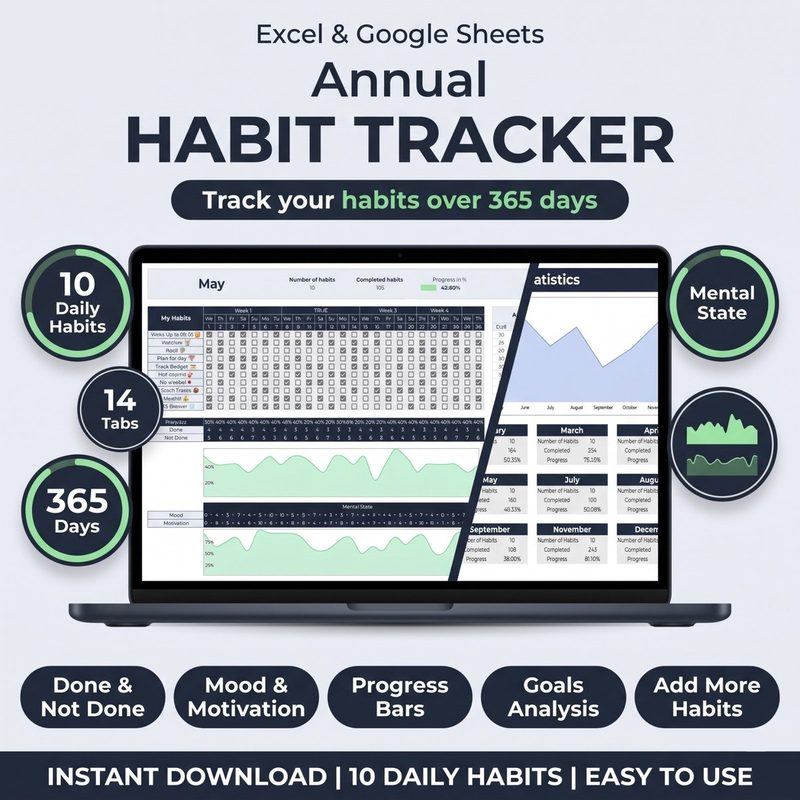
Turn focus into a trackable habit. The Habit Tracker for Excel & Google Sheets lets you log focus sessions, distractions, and energy levels next to your daily habits. One template, one place, everything that matters.
Get the Habit Tracker · $10Why Tracking Your Focus Sessions Changes Everything
There is a well-documented principle in behavior research: self-monitoring works. When people record a behavior, they perform it more consistently than people who do not record it. Dieters who log their meals lose more weight. Runners who log their miles run more often. The same applies to focus. The simple act of recording your focus sessions each day makes you more likely to protect them tomorrow.
Tracking also converts vague feelings into usable data. "I feel like I got nothing done today" becomes "I completed one focus block of 45 minutes and logged nine distractions." That data is honest in a way memory never is. Memory exaggerates effort and forgets interruptions. A spreadsheet remembers everything.
Finally, tracking creates momentum. Once you have a streak of focus blocks, you will think twice before breaking it. The same psychology that keeps a gym habit alive applies to attention: streaks are sticky.
Setting Up Your Habit Tracker Excel Template for Deep Work
Your habit tracker Excel template is built to track daily habits, and deep work fits right in. Here is how to set it up so it captures everything that matters for focus.
Step 1: Add Your Focus Habit Rows
Add one row for each focus session you plan for the day. For example: "Focus Block 1" and "Focus Block 2". Or, if you prefer a single daily row, add "Deep Work Session" as one habit and track the details in a separate log sheet. The template's monthly grid will automatically show you how many days you completed at least one focus block.
Step 2: Create a Focus Log Sheet
Create a new sheet called "Focus Log" with these columns:
| Column | What to Record | Example |
|---|---|---|
| Date | The day of the focus block. | 2026-08-03 |
| Block Start | When the focus block began. | 08:00 |
| Block End | When the focus block ended. | 09:30 |
| Total Minutes | Duration, calculated from start and end times. | 90 |
| Distractions | Every time you lost focus during the block. | 2 |
| Focus Quality | Your rating of the session from 1 to 5. | 4 |
| Notes | What worked, what interrupted you, context. | Phone in other room, deep flow after 10 min |
A simple formula that subtracts the start time from the end time computes your total minutes automatically. At the end of the week, the template can sum your deep work minutes so your weekly total is visible at a glance.
Step 3: Track Distractions as Their Own Metric
Add a "Distractions" column and count every time you lose focus during a block: checking a phone, opening a chat window, drifting to a news site. Do not judge yourself. Just count. This number is the single most informative metric you can collect about your attention.
Step 4: Rate Focus Quality
At the end of each block, rate your focus quality from 1 to 5. This adds a qualitative layer to the quantitative data. You will quickly see patterns: low quality after a bad night of sleep, high quality in the morning, a slump after lunch.
How to Schedule Focus Blocks That Actually Happen
Tracking focus is only half the battle. You also need to schedule it. If your calendar is a free-for-all, deep work will never survive contact with your inbox. Time blocking is the antidote.
Block First, Work Second
At the start of each week, open your calendar and block out your focus sessions before anything else. Treat them like meetings with the most important person in your company: yourself. Two 90-minute blocks per day, ideally in the morning, is a realistic starting point for most people.
Protect the Block
During a focus block, notifications go off, the phone goes to another room, and chat apps close. If you cannot disappear completely, communicate: set your status to "in focus mode" and schedule email checks for later. The point of the block is that nothing can interrupt it.
Batch Your Shallow Work
Email, messages, and admin tasks are not going away, but they do not need your best attention. Batch them into two or three time windows per day: once mid-morning, once after lunch, once late afternoon. When shallow work has a home, it stops invading your focus blocks.
Log each scheduled block in your habit tracker Excel template the moment it happens. Over time you will build a record of exactly how much deep work you protect each week, and that record becomes the foundation of your weekly focus review.
The Distraction Log: Track What Pulls You Away
Every interruption has a cause. The phone buzzes. A colleague stops by. You hit a hard part of the task and your brain reaches for an escape. Most people never notice these moments. They just feel scattered at the end of the day.
Your distraction log changes that. Every time you catch yourself drifting during a focus block, make a quick note in your template: what time, and what pulled you away. One word is enough: "phone", "email", "chat", "hungry", "stuck".
After one week, open the log and count the entries by cause. The pattern will be obvious. If the phone is responsible for half your interruptions, the fix is mechanical: leave it in another room during focus blocks. If "stuck" appears often, the fix is tactical: write down the next concrete action before you start the block, so you always know what to do when you stall.
The distraction log turns an abstract problem ("I can't focus") into a concrete list of fixes ("these five specific interruptions happen every day, and here is what causes each one"). That is the difference between guessing and knowing.
Log it, fix it, focus longer. Use the Habit Tracker for Excel & Google Sheets to track distractions, energy, and focus quality in one place. Know exactly what steals your attention, then remove it.
Get the Template · $10Track Your Energy, Not Just Your Hours
Two hours of deep work at your energy peak is worth four hours at your energy trough. Yet most people schedule their hardest tasks whenever the calendar has a gap, not whenever their brain is sharpest.
Your energy follows a daily rhythm, and that rhythm is personal. Some people peak early in the morning; others come alive after lunch. If you do not know your pattern, your focus log will reveal it. Rate your energy from 1 to 5 at the start of each focus block. After two or three weeks, compare average focus quality by time of day. The pattern is usually stark.
Once you know your peak window, protect it fiercely. Schedule your most demanding cognitive work there and move shallow tasks to your low-energy hours. This simple alignment, tracked in your habit tracker Excel template, can increase your output more than any productivity trick.
The Weekly Focus Review
Data without review is just storage. Set aside 15 minutes at the end of each week to review your focus log, in the same spirit as a monthly habit audit, but tighter and faster.
- Total deep hours: How many focus minutes did you log? Compare to last week. The goal is slow, steady growth, not perfection.
- Distraction trend: Is the daily distraction count falling? If it is flat, your environment has not changed. Pick one fix for next week.
- Quality trend: Are your focus blocks getting better? If quality is low, check sleep, timing, and task difficulty.
- One adjustment: Choose exactly one change for next week: a different block time, a new distraction fix, a shorter block. Small adjustments compound.
Your habit tracker Excel template holds all the data you need for this review. The numbers do not lie, and they tell you precisely what to adjust.
Common Mistakes with Focus Tracking
Mistake 1: Booking blocks you do not protect. A focus block that still allows phone checks is not a focus block. If you cannot protect the block, shrink it until you can.
Mistake 2: Blocks that are too long. Ninety minutes is the practical ceiling for most people. Past that, returns diminish sharply. Two strong 90-minute blocks beat one heroic four-hour grind.
Mistake 3: Tracking without reviewing. Logging sessions and never looking at the data is busywork. The review is where improvement happens.
Mistake 4: Counting time, ignoring distractions. Sitting at your desk for two hours with your phone in hand is not deep work. The distraction count tells you whether the block was real.
Mistake 5: Over-scheduling. Five focus blocks a day sounds impressive and collapses by Wednesday. Start with one or two protected blocks and grow from there.
Frequently Asked Questions
How many hours of deep work per day is realistic?
Three to four hours is the practical maximum for knowledge workers, and many people find one to two focused hours enough to produce their most important output. Quality beats quantity. Two protected blocks of 90 minutes, five days a week, puts you in the top tier of focused workers.
What counts as deep work?
Any task that requires your full cognitive capacity and produces lasting value: writing, coding, designing, analyzing data, planning strategy, learning a new skill. If a task could be done while watching television, it is shallow work.
How long until my focus improves?
Consistency matters more than intensity. Most people notice a real difference within three to four weeks of protecting daily focus blocks and tracking them. The improvement comes from both the practice and the data: tracking shows you what to fix, and fixing it makes the next block easier.
Should I track focus quality or just time?
Both, but if you track only one, track quality. Total minutes tell you how long you sat down. Quality tells you whether the time was real. A 45-minute block with zero distractions and a quality rating of 5 is worth more than two scattered hours.
The Bottom Line
Deep work is not a gift. It is a habit, built the same way every other habit is built: with a clear cue, a protected routine, and honest tracking. Your habit tracker Excel template gives you the structure: rows for focus blocks, columns for distractions and energy, and a monthly grid that shows your streak at a glance.
Start small. One focus block tomorrow morning. Phone in another room. Timer set. Log it in your tracker the moment it ends. Then do it again the next day.
The ability to focus deeply is the highest-leverage skill you can build, because it makes every other skill easier to learn and every other habit easier to keep. And like any habit, it starts with a single tracked day.
Schedule one focus block. Protect it. Track it in your habit tracker Excel template. Repeat tomorrow.
Build a deep work routine that lasts. The Habit Tracker for Excel & Google Sheets gives you everything you need to track focus sessions, distractions, and energy in one place. Customizable columns, monthly dashboards, and lifetime access for one price. Start protecting your attention today.
Get the Habit Tracker · $10