We put enormous energy into crafting the perfect morning routine. Wake up early, meditate, exercise, journal, drink water, crush goals. But here is the uncomfortable truth: your morning is determined by your night before.
If you go to bed at a different time every night, scroll social media until your eyes burn, or eat a heavy meal two hours before sleeping, no amount of 5 AM discipline will save your morning. The foundation of every great day is laid the previous evening.
An evening wind-down routine is a sequence of intentional habits designed to signal to your brain and body that it is time to shift from productive mode to rest mode. When you repeat this sequence consistently and track it with a habit tracker Excel template, it becomes an automatic transition that improves your sleep quality, reduces anxiety, and sets you up for a focused morning.
In this article, you will learn the science behind effective wind-down routines, how to design one that fits your lifestyle, and exactly how to track your evening habits so they actually stick.
Why Your Evening Routine Matters More Than You Think
Sleep is the single highest-leverage habit for every other area of your life. When you sleep well, your willpower is stronger, your mood is better, your decision-making improves, and your ability to stick to habits skyrockets. When you sleep poorly, everything becomes harder.
But sleep does not start when your head hits the pillow. It starts one to two hours earlier when you begin the transition from alertness to rest. This transition is called the wind-down window, and it is where most people fail. They stay in go-mode until the very last minute, then wonder why they cannot fall asleep.
Research from sleep scientists shows that a consistent pre-sleep routine can cut sleep onset latency (how long it takes to fall asleep) by up to 50%, while increasing deep sleep duration and reducing night-time awakenings. That matters more than ever in 2026: the CDC estimates that roughly one in three U.S. adults regularly gets less than the recommended seven hours of sleep, and DataReportal's Digital 2026 report puts average daily screen time at about six and a half hours — most of it on a smartphone, often in bed. And the best part? You do not need expensive gadgets or supplements. You just need a repeatable set of habits and a way to track them.
"The quality of your sleep determines the quality of your waking life. An evening wind-down routine is the bridge between the two."
: My Habit Journals
The 5 Components of an Effective Wind-Down Routine
Not all evening activities are created equal. The most effective wind-down routines share five common components. You do not need to include all five every night, but the more you incorporate, the stronger the signal to your brain that it is time to rest.
1. Digital Sunset
Blue light from screens suppresses melatonin production and keeps your brain in alert mode. A digital sunset means putting away phones, tablets, laptops, and TVs at least 30 to 60 minutes before bed. The National Sleep Foundation finds that more than 70% of adults still use screens within an hour of bedtime — making this the single most common sleep disruptor in 2026. Replace screen time with analog activities like reading a physical book, journaling, or having a conversation. This one change has the biggest impact on sleep quality for most people.
2. Dim Lighting
Bright overhead lights tell your brain it is still daytime. In the hour before bed, switch to dim, warm-toned lamps. Many people use salt lamps, candlelight, or smart bulbs set to a warm orange hue. The visual transition from bright to dim is a powerful environmental cue for relaxation.
3. Structured Unwinding
Give your brain a clear activity that signals the day is over. This could be reading fiction (not work-related material), gentle stretching, foam rolling, a warm bath or shower, or listening to calm music without lyrics. The key is that the activity is relaxing and distinct from what you do during the day.
4. Reflection and Planning
A brief moment of reflection helps your brain process the day and release unfinished thoughts. This is where your habit tracker can play a dual role. After you log your evening habits, take two minutes to write down what went well today and one thing you want to accomplish tomorrow. This practice reduces anxiety and prevents your mind from racing when you try to sleep.
5. Consistent Timing
Going to bed at roughly the same time every night (including weekends) anchors your circadian rhythm. Your body learns to predict sleep and prepares for it automatically. Consistency matters more than the exact hour. Even a 30-minute window is much better than varying by two or three hours.
How to Design Your Personal Wind-Down Routine
Your evening routine should match your lifestyle, not some ideal version of it you saw on the internet. A parent with young children will have a very different wind-down than a single professional. The goal is not perfection. The goal is a sequence you can actually follow most nights.
Here is a template to design your own. Fill in each slot with an activity that works for you:
- T-minus 60 minutes: Last caffeine cutoff (if you have not already stopped earlier). Start dimming lights.
- T-minus 45 minutes: Put away screens. Phone goes to another room or into a drawer.
- T-minus 30 minutes: Wind-down activity (reading, stretching, bath, journaling).
- T-minus 10 minutes: Open your habit tracker Excel template and log your evening habits. Review your day briefly.
- T-minus 5 minutes: Set out clothes or items for tomorrow. Write down tomorrow's top priority.
- T-minus 0 minutes: Lights out. No phone in the bedroom.
You can adjust the timing and activities. The important thing is that the sequence exists and that you track it. Tracking turns intention into evidence. When you see your evening completion rate in your habit tracker Excel template, you know exactly how consistent you are.
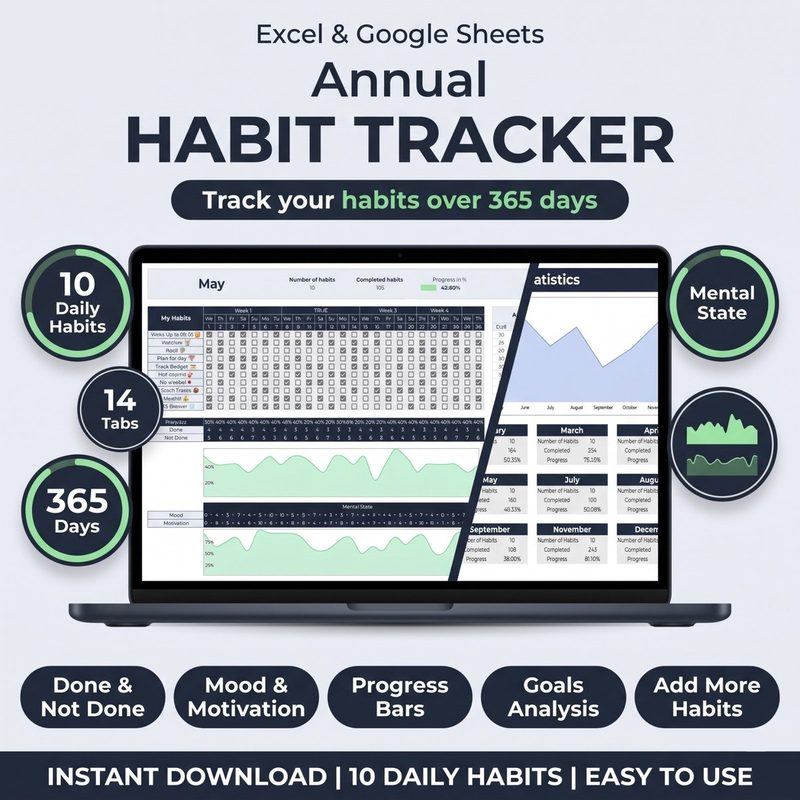
Track your evening habits with confidence. The Habit Tracker for Excel & Google Sheets lets you log nightly routines alongside your daily habits. Customize columns for digital sunset, reading, stretching, and bedtime. One template for your whole day.
Get the Habit Tracker · $10.00Which Evening Habits Should You Track?
Your habit tracker Excel template can handle as many evening habits as you want, but starting with three to five is more sustainable. Here are the most impactful evening habits to track:
1. Screen-free time before bed. This is the highest-impact evening habit. Track whether you put your phone away at least 30 minutes before sleeping. If you can only track one evening habit, make it this one.
2. Consistent bedtime. Track whether you went to bed within your target window. A simple checkbox for "in bed by 10:30 PM" creates accountability. Over time, you will see the correlation between consistent bedtime and how you feel the next day.
3. Wind-down activity. Track whether you did at least one intentional relaxation activity (reading, stretching, journaling, breathing exercise). The activity itself matters less than the consistent practice of winding down.
4. No caffeine after cutoff. If you are sensitive to caffeine, tracking your cutoff time can be a game-changer. Make it a habit checkbox in your evening section of the tracker.
5. Prepare for tomorrow. Track whether you set out clothes, packed your bag, or wrote down your top priority for the next day. This tiny habit reduces decision fatigue in the morning.
Real Example: How One User Transformed Their Sleep with Evening Tracking
James, a software developer working remote since 2020, struggled with poor sleep for years. He would stay up late coding or scrolling, then drag himself through the next day on coffee and willpower. He bought the habit tracker for Excel & Google Sheets to track his work habits, but he decided to add an evening section after reading about wind-down routines.
The first month: He added three evening habits: phone away by 10 PM, read for 15 minutes, and lights out by 10:30 PM. His first week was rough. He only succeeded two out of seven nights. But seeing the red X's in his tracker motivated him. He did not want to break his streak.
The second month: His evening habit completion rate climbed to 78%. He also added a 1–5 sleep-quality rating column, and his average score rose from 2.4 to 3.8 over the month. He noticed something: on nights he tracked his wind-down, he fell asleep faster and woke up without an alarm. The data from his tracker confirmed what he felt.
Three months later: His evening routine was automatic. He no longer needed the tracker to remind him; the habits had become part of his identity. But he kept tracking anyway because the visual record of his progress — and the correlation between his bedtime and his sleep-quality scores — was motivating in itself.
James's story is common. Once people see the connection between evening habits and morning energy, the wind-down routine stops feeling like a chore and starts feeling like the most important part of the day.
How to Set Up Your Evening Habits in Your Tracker
If you already use a habit tracker template, adding an evening section is straightforward. Here is how to organize it:
- Group your habits by time of day. Morning habits at the top, workday habits in the middle, evening habits at the bottom. A clear visual separation helps you stay focused on what matters at each part of the day.
- Use a column for bedtime time. Instead of just a checkbox, track the actual time you went to bed in a notes column. This gives you precise data to review later.
- Add a sleep quality rating. A simple 1-5 scale in your tracker helps you correlate your evening habits with how well you slept. Over weeks, you will see which habits have the biggest impact.
- Review your evening data weekly. Open your habit tracker Excel template on Sunday evening and look at your evening habit completion rates. If digital sunset is at 40% but stretching is at 90%, you know where to focus.
Ready to transform your evenings? The Habit Tracker for Excel & Google Sheets comes with customizable habit columns, weekly breakdowns, and a monthly dashboard. Add your wind-down habits today and track your way to better sleep.
Get Started · $10.00The 2026 Insight: Sleep Regularity Beats Sleep Duration
Here is the most important sleep-tracking insight of the past few years: when you sleep matters almost as much as how long you sleep. A landmark analysis of more than 60,000 participants in the UK Biobank, published in the journal Sleep, found that irregular sleep timing was a stronger predictor of mortality risk than sleep duration itself. In other words, going to bed at wildly different times every night may be worse for you than getting slightly less sleep on a consistent schedule.
Researchers call the gap between your weekday and weekend sleep schedules social jetlag — your body lives on a 10 PM bedtime, but your social life keeps you up until 1 AM on Friday and Saturday. Population studies have linked every hour of social jetlag to higher body mass index, worse metabolic health, and lower daytime energy. A weekend bedtime that drifts by two or three hours can quietly undo the progress of an entire consistent week.
This is where your habit tracker Excel template becomes a powerful analytical tool instead of a simple checklist. Checking a box for "went to bed on time" is useful, but tracking the actual time you went to bed is transformative. Here is how to track sleep regularity in 2026:
- Log the real time, not just a checkbox. In your tracker's notes column (or a dedicated "Bedtime" column), record the actual time you got into bed. After two weeks, scan the column — you will see your drift pattern instantly.
- Define a 30-minute bedtime window. Pick a target bedtime, then treat anything within 30 minutes of it as a win. Consistency within a window beats perfection on any single night.
- Set a weekend minimum, not a weekend ideal. Decide in advance how late you will allow yourself to drift (for example, "weekends: no later than 12:30 AM"). Write it in your tracker on Friday morning so the decision is made before the temptation appears.
- Correlate bedtime with your sleep-quality rating. After a few weeks, compare your 1–5 sleep-quality scores against your logged bedtimes. Most people discover a clear cutoff — bedtimes after that hour reliably produce 2s and 3s the next morning.
Tracking regularity is also forgiving. If you have one late night, the fix is not to panic — it is to return to your window the next night. This is the same "never miss twice" principle that keeps streaks alive. See our guide to recovering from a broken streak for the full strategy.
Common Obstacles and How to Overcome Them
Even with the best intentions, building an evening wind-down routine comes with challenges. Here is how to handle the most common ones.
Obstacle: "I do not have control over my evenings." If you have young children, shift work, or caregiving responsibilities, your evenings may not be your own. In that case, focus on what you can control: a 5-minute wind-down window after the kids are asleep, or a consistent bedtime even if the timing varies. Track what you can, not what you cannot.
Obstacle: "I am too tired to do a routine." This is the exhaustion paradox. The more tired you are, the more you need a wind-down, but the less energy you have to do it. The solution is to make your routine ridiculously small. One minute of stretching. Two pages of a book. A single deep breath before closing your eyes. Tiny habits compound over time.
Obstacle: "My partner keeps the TV on." Communication is key. Explain why the wind-down matters to you. Negotiate a compromise: headphones, a timer, or a separate space for your routine. Many couples find that once one person starts winding down, the other naturally follows.
Obstacle: "Weekends ruin my progress." Late nights on Friday and Saturday can undo a week of consistent tracking. The fix is not to become a monk. It is to define a weekend minimum. For example: "On weekends, I will still do a 15-minute wind-down even if I stay up later." Track the minimum, not the ideal.
The Bottom Line
Your evening wind-down routine is the foundation of everything else you do. It determines your sleep quality, your morning energy, your willpower reserves, and ultimately your ability to stick to every other habit you are trying to build.
You do not need a complex system. You need three to five simple evening habits, a habit tracker Excel template to keep you honest, and the willingness to start small. Track for one week. Review your data. Adjust. Repeat. And when you wake up, carry the momentum forward — pair this with our guide to building a morning routine that actually sticks.
The person who controls their evening controls their tomorrow. Start tonight.