We tend to think of discipline as a trait you either have or you don’t. The “disciplined” ones wake up early, crush workouts, and never miss a deadline. The rest of us struggle to keep a new habit for two weeks.
But this framing is wrong. Discipline is not a genetic gift : it’s a trainable skill, and the most effective way to build it is surprisingly simple: track your habits.
Habit tracking turns the abstract idea of “being more disciplined” into something concrete and measurable. Each checkmark is a small vote for the person you want to become. Over time, those votes compound into lasting self-discipline.
In this article, we’ll explore why tracking outperforms willpower, how measurement makes discipline visible, and why streaks create unstoppable momentum.
Measurement Makes Discipline Visible
The biggest reason most people fail at building discipline is invisibility. When a habit exists only in your head, it’s fuzzy. You “kinda sorta” worked out yesterday. You “think” you read for ten minutes. That vagueness kills consistency.
Measurement changes everything. Recording each action creates a visual record of your behaviour. A habit tracker transforms an intention into a data point. You can no longer lie to yourself about whether you showed up.
This is the Hawthorne Effect in action: people modify their behaviour when they know they’re being observed. Here, you’re the observer. Opening your tracker and marking a habit creates a moment of accountability that wouldn’t exist otherwise.
Over time, the data reveals patterns. You might discover your meditation habit crumbles on days you skip breakfast, or that your best writing happens after a morning walk. These insights let you optimise your environment instead of relying on brute force.
Without measurement, discipline is a feeling. With measurement, it’s a system.
“What gets measured gets managed. What gets managed gets improved. Tracking is the bridge between wanting to change and actually changing.”
: Adapted from Peter Drucker
Why Tracking Beats Willpower
Willpower is a finite resource. Research by Roy Baumeister shows that self-control depletes throughout the day like a muscle that fatigues with use. Relying on willpower alone is a losing strategy : especially when your reserves are drained in the afternoon.
Habit tracking sidesteps this problem entirely. Instead of requiring a fresh decision (“Should I work out today?”), tracking turns it into a simple binary: Did I do it or didn’t I?
Here’s why that shift matters:
- It removes decision fatigue. You’re not debating whether to act. You’re recording whether you did. The habit becomes automatic; the tracker is just the ledger.
- It creates immediate feedback. Willpower offers delayed gratification. Tracking rewards you right now : the satisfaction of checking a box. That dopamine hit reinforces the behaviour better than vague promises.
- It externalises accountability. When a habit lives on a tracker, it carries weight. Leaving a cell empty for three days feels different than “not getting around to it.” The visual gap nags at you in a way a forgotten intention never does.
- It reduces cognitive load. A tracked habit no longer requires mental energy. It becomes part of your routine. Your brain focuses on higher-level decisions instead.
Think of willpower as a sprint and tracking as a pace car. One burns out fast; the other keeps you moving day after day without exhausting you.
How Streaks Create Momentum
There is perhaps no more powerful motivational force in habit formation than a streak. Once you’ve strung together five, ten, or thirty consecutive days, something shifts. You stop wanting to break the chain.
Jerry Seinfeld famously used this technique to become a better comedian. He hung a calendar and marked a red X through every day he wrote jokes. His only job: “don’t break the chain.” The streak became its own reward.
Here’s why streaks work for building discipline:
- The endowment effect kicks in. You value something you already possess. A 14-day streak feels like yours, and losing it hurts more than the effort to maintain it. Loss aversion becomes your ally.
- Streaks compound identity. After week two, you see yourself as “the kind of person who exercises daily” instead of “someone trying to exercise more.” Tracking makes that identity shift visible.
- Momentum reduces resistance. The hardest workout is always the one after a long break. Streaks eliminate restart costs. Each day you continue, the next gets fractionally easier.
- Streaks gamify the process. A counter ticking upward satisfies a primal need for progress. It turns habit maintenance into a game you’re winning.
The beauty of streaks is that they require no additional motivational fuel. The streak itself generates the motivation. You don’t need to “find the energy” on day 22 : you just don’t want to break it. That’s far more reliable than enthusiasm, which fades, or willpower, which depletes.
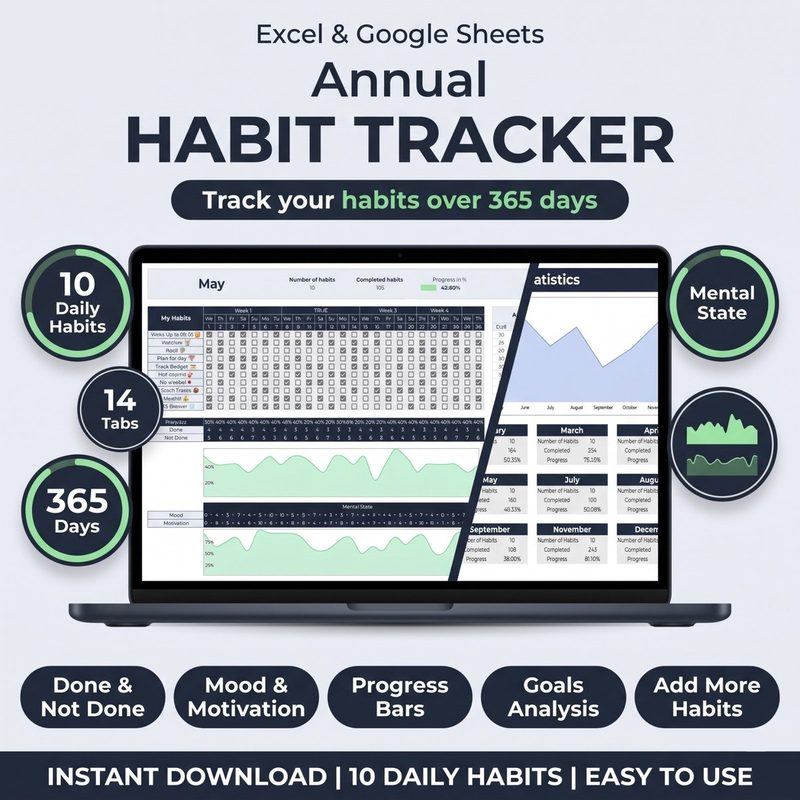
Ready to put this into practice? The Habit Tracker for Excel & Google Sheets makes it easy to track daily habits, monitor streaks, and see your discipline grow over weeks and months. One purchase, lifetime access.
Get the Habit Tracker · $10The Compound Effect: Why 1% Daily Adds Up
James Clear popularised the idea that improving by 1% each day leads to a 37-fold improvement over a year. But that formula only works if you show up every day. Tracking makes that possible.
Each checkmark is a 1% gain. Each empty cell is a 1% regression. Over a year, that difference is transformational : not just in the habit itself, but in the discipline muscle you’re strengthening every time you mark an action complete.
Consider two people. Person A decides to “be more disciplined” and relies on motivation. Person B starts tracking daily. After three months, Person B has a visual record of progress, a streak they don’t want to break, and a habit that has become automatic. Person A is back to square one, waiting for another surge of motivation.
That’s not because Person A is weaker. It’s because they lacked a system. Tracking is the system.
Practical Tips for Using Tracking to Build Discipline
If you’re ready to start, follow these principles:
- Start with three habits maximum. Pick the three that will have the biggest impact and track those until they become automatic.
- Keep it simple. A binary checkbox (done / not done) is more effective than a rating scale. The simpler the log, the more likely you’ll maintain it.
- Don’t break the chain. Once you start a streak, prioritise maintaining it. On low-energy days, do the minimum viable version : a five-minute walk counts as exercise.
- Review weekly. Spend five minutes every Sunday looking at your tracker. Which habits are consistent? Which are slipping? The review turns tracking into insight.
- Forgive slip-ups immediately. A missed day is not a failed habit. Log it, note what happened, and pick up the next day. Perfectionism is the enemy of consistency.
These principles work because they respect the psychology of discipline. They don’t demand superhuman willpower. They make the right thing easier to do, day after day.
Discipline is not a destination; it’s a practice. You don’t arrive at being disciplined and then coast. You maintain it through daily action, and the best tool for that is a habit tracker Excel template.
Measurement makes discipline visible. Tracking removes reliance on willpower. Streaks generate their own momentum. Together, these forces turn “being more disciplined” into something concrete and achievable.
The most disciplined people aren’t those with infinite willpower. They’re the ones who built a system that makes discipline the default. A habit tracker is that system.
One checkmark at a time, you’re not just tracking habits. You’re building the person you want to become.
Build your discipline today. Download the Habit Tracker for Excel & Google Sheets and start tracking the habits that matter most. Includes streak tracking, progress dashboards, and monthly reviews.
Get Started · $10