You have probably tried to overhaul your entire life in a single week. Wake up earlier, go to the gym, meal prep, read more, save money, journal nightly. By Thursday, half of them are gone and the other half feel like a second job. Trying to change everything at once is the most common reason habit attempts fail.
There is a smarter path. Instead of chasing ten habits, you install one. Not any habit, but a keystone habit: a single routine that triggers positive chain reactions across your whole day. Exercise is a classic example. People who start working out often report that they also start eating better, sleeping more, and procrastinating less, even though nobody told them to change those things. The habit leaked.
In this guide you will learn what makes a habit a keystone, how to find the one that fits your life, a 30-day plan to install it, and how to use your habit tracker Excel template to prove the ripple effects are real. By the end, you will stop juggling habits and start compounding them.
What Exactly Is a Keystone Habit?
The term comes from Charles Duhigg's book The Power of Habit. In architecture, a keystone is the wedge shaped stone at the top of an arch. Remove it, and the whole structure collapses. In behavior, a keystone habit is a routine with outsized leverage: once it becomes automatic, it nudges other habits to form on their own.
The key word is leverage. A keystone habit is not the most impressive habit, and it is rarely the hardest. It is the one that changes the conditions around everything else. Going to bed at a consistent time is unglamorous on its own, but it makes early workouts possible, which makes better food choices easier, which makes focus at work more reliable. One decision, a cascade of consequences.
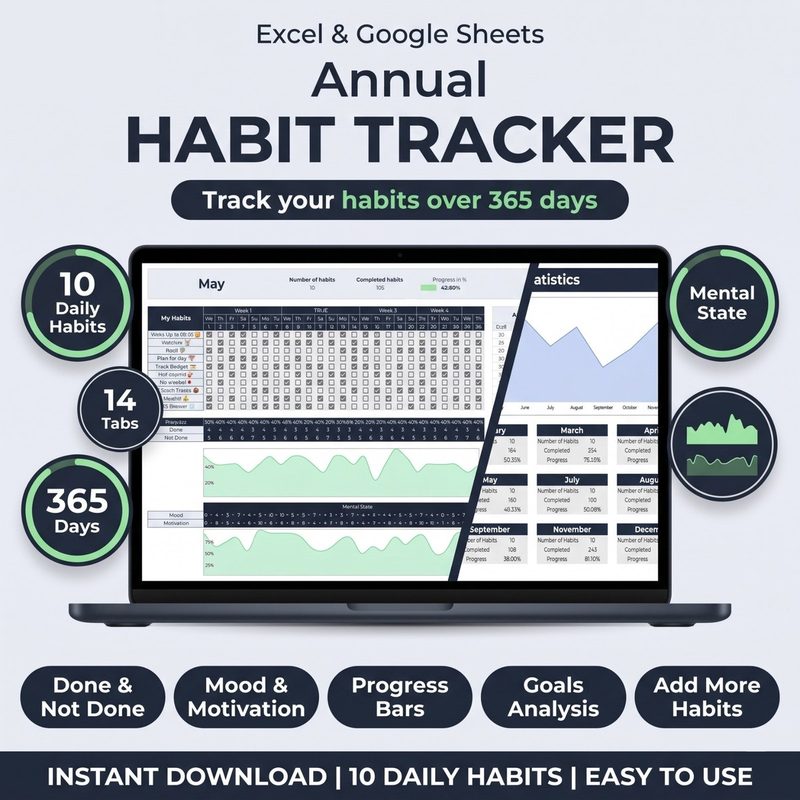
This is why keystone habits matter for tracking. Most people track the outcomes they want (weight, output, mood) instead of the lever that moves them. Your habit tracker Excel template is built to track both: the single keystone you commit to, plus the secondary habits that start improving on their own.
"Change one habit and you change the trajectory of a hundred small decisions you never consciously make."
: My Habit Journals
Classic Keystone Habit Examples
Research on habit change keeps pointing back to a small set of routines that produce disproportionate results. Here are the most reliable keystone habits people actually stick with:
- Regular exercise. The most studied keystone. A workout habit tends to improve sleep, diet, stress, and even spending habits. The mechanism is likely the small win feeling it creates early in the day.
- Food journaling. In weight loss research, people who simply record what they eat tend to lose more weight than those who only diet. The act of writing makes the invisible visible.
- Making your bed. Tiny, but it starts the day with a completed task. That first checkmark sets a tone of order that carries into work.
- A consistent sleep schedule. Fixed wake and bed times stabilize energy, which makes every other habit easier to execute.
- Daily planning. Spending five minutes deciding tomorrow's top three tasks reduces decision fatigue and improves follow through all day.
Notice that none of these depend on willpower in the moment. They change the environment and the energy you bring to the rest of the day. That is the signature of a keystone.
Track the lever, not just the outcome. The Habit Tracker for Excel & Google Sheets lets you track a single keystone habit alongside the secondary routines it influences, with automatic streaks and a monthly dashboard that shows the ripple.
Get the Habit Tracker · $10Why Keystone Habits Work: The Spillover Effect
Behavioral researchers describe two forces behind keystone habits. The first is small wins. A small win is a minor but real accomplishment that shifts how you see yourself. When you finish a workout, you feel like someone who trains. That self image quietly rewrites later choices. You order the salad not because you were disciplined, but because it matches the person you just became.
The second is spillover. When one area of life gains structure, adjacent areas borrow that structure. A morning workout forces an earlier bedtime. An earlier bedtime makes you less likely to snack late. Less late snacking improves morning energy, which protects the workout. The habits start to support each other in a loop.
This is exactly why keystone habits are worth tracking carefully. Your habit tracker Excel template turns a vague feeling of "I think things are getting better" into a row of checkboxes you can point to. When you can see that your sleep improved in the same month you started walking daily, you stop second guessing and start doubling down.
How to Find Your Keystone Habit
There is no universal keystone habit. The right one for you depends on where your current routines break down. Use this simple audit to locate yours.
Step 1: Map the day you actually have
For three days, write down what really happens (not the idealized version). When do you wake? When do you lose focus? When do you reach for your phone or a snack? Patterns will surface fast. Most people find two or three recurring low points: a sluggish morning, an afternoon crash, a chaotic evening.
Step 2: Ask what one change would soften the most low points
If your mornings are sluggish, a fixed bedtime is your keystone. If your afternoons collapse, a short walk or a planning break may be it. If your evenings spiral, a wind-down routine is the lever. The keystone is the habit that touches the most pain points at once.
Step 3: Test small for one week
Do not commit for life. Run a seven day trial. Track it in your habit tracker Excel template and note one secondary habit you want to watch. If the keystone starts nudging that secondary habit, you found it. If nothing moves, try a different lever next week.
Step 4: Watch for the domino
The tell of a true keystone is that something else improves without you forcing it. Bedtime improves, and suddenly you have energy to make breakfast. Planning improves, and your inbox gets handled faster. That unsolicited domino is your signal to lock the habit in.
The 30-Day Keystone Installation Plan
Once you have your candidate, install it deliberately. Here is a month long structure that leans on your tracker to stay honest.
- Days 1 to 7: Make it ridiculously small. Shrink the keystone until it is almost too easy. Five minutes of movement, a two minute planning session, lights out fifteen minutes earlier. A keystone needs to be unbreakable before it can be powerful.
- Days 8 to 14: Anchor it to an existing routine. Attach it to something you already do without thinking. After I pour my coffee, I plan my top three. After I brush my teeth, I lay out workout clothes. The anchor makes the new habit automatic faster.
- Days 15 to 21: Track the secondary habit too. Add one downstream habit to your tracker and watch whether it starts to follow. This is where your habit tracker for Excel and Google Sheets earns its keep, because you are proving a causal link, not hoping for one.
- Days 22 to 30: Protect the streak, not your ego. If you miss a day, follow the two day rule and never miss twice. The goal of month one is not perfection. It is to end the month with the keystone still alive and at least one ripple visible in your data.
How to Set Up Keystone Tracking in Your Template
Your habit tracker Excel template already handles daily checkboxes and streaks. A few small tweaks turn it into a keystone detector:
- Give the keystone its own highlighted row. Place it at the top and color it differently so it reads as the priority habit, not one among many.
- Add a "Ripple" row. Pick one secondary habit you expect to improve and track it directly beneath the keystone. Compare their completion rates at month end.
- Use a Notes column for context. On days the keystone happens, jot one word about how the rest of the day felt. Over a month, these notes reveal the spillover pattern.
- Check the monthly dashboard. Look at whether the keystone's completion percentage maps to improvements in the ripple habit. That visual evidence is what keeps you committed when motivation dips.
- Review quarterly, not daily. Keystones work slowly. Judge them across a full month or a quarter, not a single bad week.
Build your keystone tracker today. The Habit Tracker for Excel & Google Sheets includes customizable habit rows, streak formulas, a notes column, and a monthly dashboard made for spotting ripple effects. One time purchase, lifetime access.
Get the Template · $10Common Keystone Habit Mistakes
Even with the right habit, a few traps derail the process. Watch for these.
Choosing a keystone that is actually an outcome. "Lose weight" or "be more productive" are results, not routines. You cannot check them off daily. Convert them into the behavior that produces them: a daily walk, a planning session, a fixed bedtime.
Tracking too many habits at once. The whole point of a keystone is that one habit pulls others along. If you fill your habit tracker Excel template with twelve rows on day one, you are back to the all at once trap that fails almost every time. Start with one keystone and one ripple.
Expecting instant dominoes. Spillover takes weeks. Do not abandon a keystone because your secondary habit has not improved by day five. Give it a full month before you judge.
Confusing a keystone with a favorite habit. People often pick the habit they enjoy most rather than the one with the most leverage. Be honest about where your day actually breaks down, not where you enjoy spending effort.
Frequently Asked Questions
How many keystone habits should I have?
One at a time, at least while it is still forming. Once your first keystone is automatic (usually after four to eight weeks), you can add a second. Trying to run three keystones at once defeats the purpose, because you lose the clarity of seeing which habit is driving the change.
What if my keystone habit does not create any ripple effects?
Then it might not be a true keystone for you. That is useful information, not a failure. Review the data in your tracker, identify a different pain point in your day, and test a new lever. Finding the right keystone is a process of elimination.
Is exercise always the best keystone habit?
It is the most studied and works for many people, but it is not universal. For someone with a chaotic schedule, daily planning may move more needle. For someone chronically short on sleep, a fixed bedtime beats any workout. Match the keystone to your weakest link.
Can I track a keystone habit in Google Sheets as well as Excel?
Yes. The habit tracker template works in both Excel and Google Sheets, so you can check off your keystone from a laptop, a phone, or a tablet, whichever is closest when the habit happens.
How do I know the ripple effect is real and not just a good week?
Look at your monthly dashboard across two or three months. If the keystone's completion percentage tracks with improvements in your secondary habit over time, that is a pattern, not a fluke. Your habit tracker Excel template stores the history that makes this comparison possible.
The Bottom Line
You do not need to fix ten habits to change your life. You need to find one habit with leverage, make it unbreakable, and let it pull the rest of your routines into place. That is the entire promise of keystone habits, and it is far kinder to your willpower than an overnight overhaul.
Start by auditing your week for the low points. Choose the single habit that touches the most of them. Track it in your habit tracker Excel template alongside one downstream habit you want to see improve. Then give it a month of honest, consistent checkboxes before you judge the results.
When you find your keystone, you stop fighting yourself one habit at a time. You start moving the whole structure with a single stone. Open your tracker, pick the lever, and make today's checkbox the first domino.