Most people start tracking habits with great enthusiasm. They check boxes, build streaks, and feel the satisfaction of visible progress. But after a few months, something curious happens: the tracker fills up, yet the results plateau.
The reason is simple. Tracking without review is just data collection. It tells you what happened, but not why. It shows whether you did something, but not whether that thing is working. The difference between people who get great results from habit tracking and those who stagnate is a simple practice: the monthly habit audit.
A habit audit is a dedicated time each month where you step back from the daily grind and look at your tracking data with fresh eyes. You ask hard questions, find patterns, and make deliberate changes. It is the difference between driving with your eyes on the road and occasionally checking the map to see if you are still heading the right way.
In this article, you will learn exactly how to run a monthly habit audit using a habit tracker Excel template, what to look for in your data, and how to turn those insights into smarter habits next month.
Why a Monthly Audit Matters More Than Daily Tracking
Daily tracking is about accountability. It keeps you honest and present. But it has a blind spot: you cannot see the forest while counting the trees. Day-to-day fluctuations in energy, mood, and context make it hard to judge whether a habit is truly working.
A monthly view changes that. With a full month of data, small patterns become visible. You might discover:
- Your workout consistency drops in the third week of every month.
- You read more on days you also meditate.
- Your sleep habit suffers on weekends even though you thought it was stable.
- A habit you started with enthusiasm has become a chore you only half-heartedly complete.
These insights are invisible at the daily level. They only emerge when you zoom out and look at the data as a whole. That is what the monthly audit provides.
"The habit that got you here will not take you there. Review is how you find out which habits to keep, which to drop, and which to upgrade."
: My Habit Journals
Step 1: Gather Your Data
Before you can analyze anything, you need your tracking data in one place. If you use a habit tracker Excel template, this step is already done for you. The monthly overview or dashboard tab aggregates your daily checkmarks into percentages, streaks, and trend lines.
If you track manually or use a different method, export or compile your data for the past month. You want to see:
- Completion rates for each habit (what percentage of days did I follow through?).
- Streak lengths (longest and current streaks for each habit).
- Weekly breakdowns (how did each week compare to the others?).
- Notes or context (any annotations about why you missed days).
The goal here is not judgment. It is simply getting a clear, honest picture of what happened. A good habit tracker template will already have a summary dashboard with these metrics calculated automatically.
Step 2: Ask the Five Audit Questions
With your data in front of you, work through these five questions for each habit you tracked. Write down your answers. The act of writing forces clarity.
1. Did I actually do it?
Start with the raw numbers. Look at completion rates, not feelings. An 80% completion rate is very different from 40%, and both are different from what you might have guessed without data. Be honest with yourself. If a habit has a completion rate below 50%, something is not working.
2. Was it worth the effort?
Completion rate is not the only metric. Some habits deliver huge returns for minimal time investment. Others eat up energy with little visible payoff. Ask yourself: if I could not do this habit for a month, would I notice? If the answer is no, consider dropping it or replacing it.
3. Where did I stumble?
Look for patterns in your misses. Do you consistently skip this habit on certain days of the week? After certain events? At certain times of day? These patterns reveal environmental triggers, not character flaws. If you always miss your evening reading habit on late work days, the fix is not "try harder." The fix is to schedule reading before work instead.
4. Is it still aligned with my goals?
Habits that made sense three months ago might no longer serve you. Maybe you started tracking water intake to improve energy, but you have since built that intuition and no longer need the tracker. Or maybe a new priority emerged that deserves more attention. The audit is a chance to realign your habits with your current goals.
5. What is one adjustment I can make?
For each habit, identify exactly one change for next month. It might be adjusting the time of day, lowering the bar for what counts, adding an accountability trigger, or swapping the habit for something better suited to your current life. One small adjustment per habit keeps the process manageable.
Step 3: Identify Cross-Habit Patterns
The most powerful insights come from looking at how your habits interact. A habit tracker Excel template with multiple columns and rows allows you to see correlations that you would miss otherwise.
Here are some common cross-habit patterns to look for:
- The domino effect. When habit A goes well, habit B almost always follows. This tells you which habit to prioritize as your keystone.
- The drain effect. When habit C happens, habit D always suffers. This might mean habit C is too demanding, or habit D is scheduled at a bad time.
- The weekend drift. Your weekday habits are strong, but weekend tracking falls off. Consider whether your weekend routine needs its own habit tracker template or a separate set of expectations.
- The fatigue spiral. A habit done late in the day has lower completion and quality. Try moving it earlier.
These cross-habit insights are where the magic happens. They let you redesign your daily routine based on actual evidence rather than guesswork.
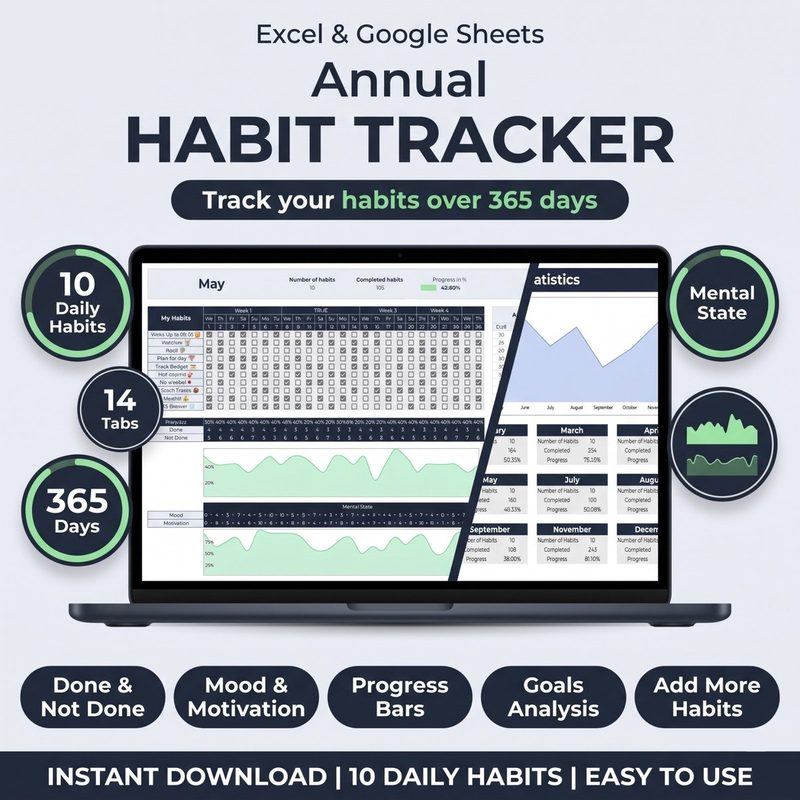
Spot patterns in your own data. The Habit Tracker for Excel & Google Sheets includes a monthly dashboard with completion percentages, streak tracking, and weekly breakdowns. With all your data in one place, running a monthly audit takes minutes instead of hours.
Get the Habit Tracker · $10Step 4: Decide What to Keep, Drop, Add, or Adjust
Based on your audit, sort each habit into one of four categories:
Keep. These habits are working well. High completion rate, clear benefit, good energy return. Keep doing exactly what you are doing. Do not fix what is not broken.
Adjust. These habits have potential but need a tweak. Maybe the time of day is wrong, the frequency is too high, or the definition is too strict. Pick one adjustment and commit to it for the next month.
Drop. These habits no longer serve you. Maybe they solved a problem you no longer have, or they never delivered the benefit you expected. Dropping a habit is not failure. It is freeing up energy for something better.
Add. Based on your goals and the patterns you noticed, is there a new habit that could fill a gap? Perhaps your data shows you feel better on days you step outside, so adding a five-minute walk habit makes sense. Do not add more than one new habit per month. Overloading leads to collapse.
Step 5: Set Your Next Month Intentions
With your decisions made, update your tracker for the coming month. Remove dropped habits. Adjust the parameters of adjusted ones. Add the new habit if you chose one. Then set your intentions clearly:
- What is the minimum bar? Define the smallest version of each habit that counts as success. On low-energy days, you need a floor that keeps the streak alive.
- What is your trigger? Link each habit to an existing routine. "After I pour my morning coffee, I will meditate for two minutes." The trigger makes the habit automatic.
- When will you do the next audit? Schedule it now. Put a recurring calendar reminder for the same date next month. Thirty minutes is enough for a thorough review.
Write down your intentions somewhere visible. Many people find it helpful to keep a short note at the top of their tracker for the month: "This month I am focusing on consistency with exercise and adding a wind-down reading habit." A single sentence is enough to keep you oriented.
What a Monthly Audit Looks Like in Practice
Here is a real example from a user of the habit tracker Excel template:
Before the audit: Sarah tracked 8 habits daily. Her completion rates were around 60-70% for most of them, but she felt like she was just going through the motions. She was not sure which habits were actually helping.
During the audit: She noticed three things. First, her "drink 8 glasses of water" habit had a 90% completion rate but she did not feel any different. Second, her "read 20 pages" habit died on days she worked late, but her "10-minute stretch" habit never missed. Third, she saw that on days she meditated, her patience with her kids was noticeably better.
After the audit: She dropped water tracking entirely (she had built the intuition). She moved reading from evening to lunchtime. She kept meditation and upgraded it from "nice to have" to her number one priority habit. She replaced time-tracking (which she never reviewed) with a new evening wind-down routine. Her completion rate the following month jumped to 85%, and she felt more aligned with what mattered.
That is the power of a monthly audit. It does not require more effort. It requires smarter effort.
Common Monthly Audit Mistakes
Even with the best intentions, it is easy to fall into traps during the review process. Here are the most common ones and how to avoid them.
Mistake 1: Being too harsh on yourself. The audit is not a report card. It is a diagnostic tool. If you see low numbers, resist the urge to label yourself as lazy. Instead, ask what environmental or scheduling factors caused the misses. Self-criticism shuts down insight.
Mistake 2: Changing everything at once. If you find five things to adjust, pick the two most impactful. Changing too many habits at once overwhelms your capacity for consistency. Monthly audits are iterative, not revolutionary.
Mistake 3: Skipping the audit entirely. The most common mistake of all. Life gets busy, you tell yourself you will remember the insights, and another month passes without review. The only remedy is a scheduled, non-negotiable calendar block. Treat the audit as seriously as the tracking itself.
Mistake 4: Comparing your data to someone else's. Your habits, your life, your goals. A 60% completion rate might be transformational for you even if someone else is at 95%. Context matters. Only compare yourself to where you were last month.
Tools That Make the Audit Easy
You do not need complicated software to run a good monthly audit. But certain features make the process dramatically faster:
- Automatic completion percentages. Instead of counting checkmarks manually, let your tracker calculate them for you.
- Weekly breakdowns. See how each week compared so you can identify mid-month slumps.
- Streak tracking. The longest streak tells you your potential. The current streak tells you your momentum.
- Notes fields. A place to jot down why you missed or what felt different on certain days.
The Habit Tracker for Excel & Google Sheets includes all of these features in a single dashboard view. Monthly overview, weekly breakdowns, streak tracking, and space for notes. It is built for exactly this kind of review.
Run your first monthly audit. Download the Habit Tracker for Excel & Google Sheets and start with one month of tracking. When the month ends, use the dashboard to review your data and refine your approach. One purchase, lifetime access.
Get Started · $10The Bottom Line
Tracking habits without reviewing them is like taking a shower without drying off. You did the work, but you are not getting the full benefit. A monthly habit audit takes thirty minutes and turns raw data into actionable intelligence.
You discover what works and what does not. You see patterns that were invisible day to day. You make small, smart adjustments that compound over time. And most importantly, you prevent the slow drift that happens when habits become automatic but misaligned.
The most successful habit trackers are not the ones with perfect 100% streaks. They are the ones who use their tracking data as a feedback loop. Check, review, adjust, repeat. That is the pattern that turns good intentions into lasting change.
Schedule your monthly audit for next Sunday. Open your tracker. Look at your data. Ask the five questions. And make one small change. That is all it takes to turn tracking into transformation.