You buy the book with real excitement. You read thirty pages the first night. Then work gets busy, the phone wins the evening, and two weeks later the bookmark has not moved. The book was never the problem. You simply never gave reading a fixed place in your day, so it lost to everything that did have one.
Reading is the classic habit people want but rarely schedule. It produces no urgent deadline, and no one notices when you skip a night. That is exactly why it needs a tracker. Left to chance, reading always finishes last. Given a slot and a checkbox, it quietly becomes one of the most rewarding parts of your routine.
In this guide you will learn why the reading habit is so hard to keep, how to shrink it small enough to start tonight, and how to log pages, minutes, and finished books in your habit tracker Excel template so your progress becomes a number you can grow.
Why the Reading Habit Is So Easy to Lose
Three quiet forces work against every reading habit. Understanding them is half the cure.
- Reading has no natural trigger. Brushing your teeth, eating lunch, and driving to work all happen on cue. Reading happens whenever you happen to remember. A habit with no cue has to rely on willpower, and willpower is the least reliable tool you own.
- The reward is delayed. A short video gives you a hit in seconds. A chapter pays off over days. Your brain favors the fast reward unless the slow one is made visible, which is exactly what a tracker does.
- The friction is higher than it looks. If the book is on the shelf across the room, the phone is in your hand, and you do not know what page you left off, starting takes real effort. Reduce the friction and the habit becomes almost automatic.
None of this means you lack discipline. It means reading was never set up to succeed. Fix the setup and the habit nearly runs itself.
The Core Rule: Make Reading Almost Too Small to Skip
The biggest mistake is starting with an ambitious target. Read one hour a day, finish a book a week, get through the whole shelf. These goals feel motivating for about four days and then collapse under their own weight.
Flip it. Set a floor so low it feels silly. Read one page a day. That is the habit. Not one chapter, not thirty minutes, one page.
On most days, one page turns into ten. The point is that you never have a legitimate reason to skip. A tired Tuesday still leaves room for one page, and the unbroken chain of days is what rewires the routine. The goal is not the page count. The goal is showing up, and showing up is what you track.
"You do not rise to the level of your reading goal. You fall to the level of your reading habit. Make the habit small enough that falling still lands on a page."
: My Habit Journals
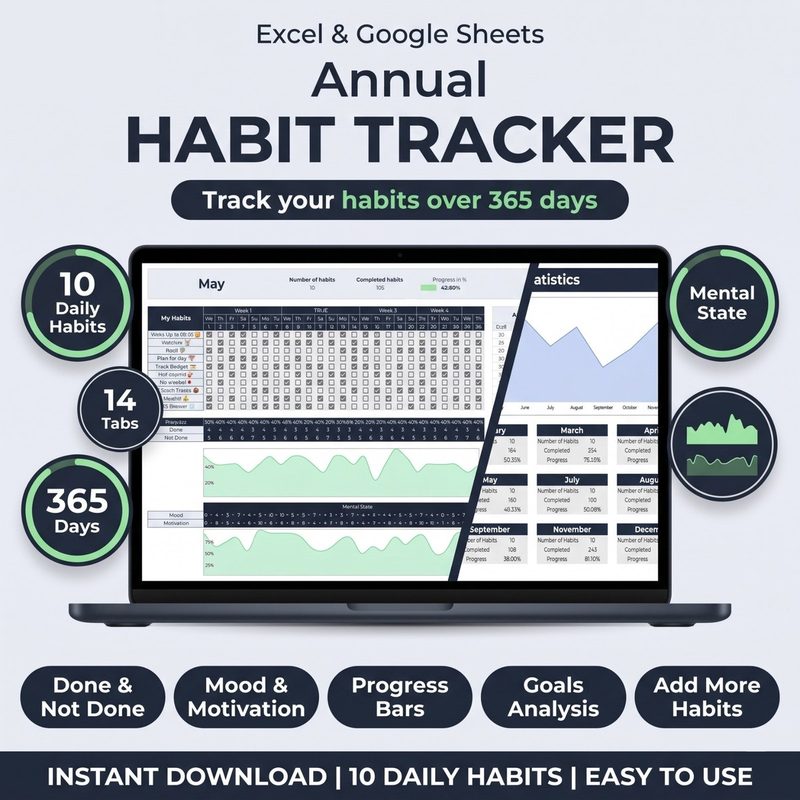
Give reading a home you can see. The Habit Tracker for Excel & Google Sheets lets you log daily pages, minutes, and finished books, then watch your reading streak build week after week.
Get the Habit Tracker · $10How to Set Up Your Reading Habit in 5 Steps
You can build the whole thing in one sitting. Here is the process.
Step 1: Pick the anchor
Attach reading to something you already do every day without fail. The classic choices are with your morning coffee, right after lunch, or in bed before lights out. When the existing habit fires, the new one rides along. This is the same cue based approach that makes any routine stick, and reading is one of the easiest habits to anchor because you can do it almost anywhere.
Step 2: Shrink the action
Decide your floor: one page, or five minutes. Write it down exactly. A precise, tiny action beats a vague, ambitious one every single time. You can always do more, but the floor is what you commit to and what you mark off.
Step 3: Remove the friction
Put the book where the habit happens. On the coffee table, on your pillow, next to the kettle. Keep your phone in another room during your reading slot. A book within arm's reach beats a book on a shelf, and it beats a glowing screen almost every time.
Step 4: Choose one book at a time
Reading several books at once fragments your attention and slows every finish. Pick one. Finish it, or decide on a set date that you are abandoning it on purpose, then start the next. Serial reading produces the finished book count that feels so motivating to log.
Step 5: Track it the moment you finish
Open your habit tracker Excel template and mark the day before the feeling passes. A checkmark submitted on the spot is worth ten remembered in your head the next morning. This two second ritual is the entire habit loop, closed.
What to Track in Your Habit Tracker Excel Template
Reading is richer than a simple yes or no, so your tracker can capture more than most habits. Here is a simple structure that stays useful without becoming a chore.
- Days read. One checkbox per day, kept as a monthly grid. This is your streak and the backbone of the whole habit.
- Pages read. A number column for the actual pages you finished. Some days it is one, some days it is forty. The totals add up faster than you expect.
- Minutes read. Optional, but useful if you listen to audiobooks, since minutes capture time that pages cannot.
- Current book and page. A small note of the title and where you stopped, so you never waste a session finding your place.
- Books finished. A running list of titles and finish dates. This is the reward column, and it grows into a record of everything you have read.
Reading Habits That Actually Move the Needle
Beyond the daily page, a few supporting habits make reading easier to sustain.
Carry the book everywhere. Waiting rooms, queues, and commutes are reading time hiding in plain sight. A book on your phone in a reading app counts too, and it turns dead minutes into pages.
Read two books in parallel, one fiction and one nonfiction. Matching the book to your energy is easier when you have a choice. A tired evening suits a novel, a sharp morning suits ideas.
Keep a tiny reading note. One line about what you read cements it in memory and gives the habit a purpose beyond page count. It also makes your tracker a genuine journal over time.
Protect a nightly wind down. Replacing even ten minutes of screen time with a book improves both your reading habit and your sleep. The two habits reinforce each other, which is the quiet magic of stacking routines.
Common Reading Habit Mistakes
Most reading intentions die for the same few reasons. Avoid these and yours keeps going.
Chasing a book you do not enjoy. Life is short and your reading time is precious. If a book is a slog after fifty pages, you are allowed to stop. Guilt about quitting is the fastest way to quit reading altogether.
Setting a page target too high. Fifty pages a day sounds fine until a busy week arrives and you miss three days in a row. A missed target stings, and the sting is what triggers abandonment. Keep the floor low and celebrate the surplus instead.
Never logging the finish. When you close a book, add it to the finished list in your habit tracker Excel template the same day. The visible pile of finished titles is the strongest motivator you have, and it is easy to forget if you wait.
Reading only when you feel like it. Mood based habits fade in busy seasons. Scheduled habits survive them. Anchor reading to a fixed cue and treat it like an appointment, not a mood.
Frequently Asked Questions
How many days does it take to build a reading habit?
There is no magic number, but most people find the routine feels automatic after about three to four weeks of unbroken daily practice. Track the streak and let the visible chain pull you forward one day at a time.
Do audiobooks count as reading?
For habit purposes, yes. If you listen during a commute or a walk, log the minutes and count the book as finished. The goal is consistent engagement with long form ideas, and audio does that just as well.
What if I miss a day?
Never miss twice. One skipped day is a blip. Two in a row is how a habit starts to die. Read even one page the next day and your streak logic stays alive in your head, which matters more than the exact count.
Can I track my reading in Google Sheets as well as Excel?
Yes. The habit tracker template works in both Excel and Google Sheets, so you can log pages from your laptop or your phone and keep the same record wherever you are.
How many books a year is realistic?
Twelve books, one a month, is a gentle goal that a ten page daily habit clears easily. Twenty to thirty is reachable if you protect a longer daily block. Forget the number and build the daily habit first, then let the total surprise you.
The Bottom Line
Reading more is not a matter of finding extra time. It is a matter of giving reading a fixed place to live and making progress visible. Anchor it to something you already do, shrink it to a single page, and log it in your habit tracker Excel template the moment you finish.
Do that for a month and something shifts. The book moves off the shelf and into your evenings. The finished list grows past a handful of titles. And the habit that once felt like self improvement becomes something you genuinely look forward to.
Start tonight. One page, one checkmark, and a reading habit that finally outlasts the good intentions.