Every morning you brush your teeth without deciding to. You reach for your phone before you consciously choose to. You grab coffee, tie your left shoe before your right:all on autopilot.
These aren't one-off decisions. They are habits: automatic routines wired into your neural circuitry through repetition. Understanding how they form is the most powerful tool you have for changing your life.
But there's a catch. The same mechanism that makes bad habits stick also makes good ones hard to build:unless you use the right lever. That lever is tracking. This article unpacks the psychology behind habit formation and reveals why writing down your progress turns intention into automatic behavior.
The Habit Loop: Cue, Routine, Reward
In The Power of Habit, Charles Duhigg introduced a framework neuroscientists had been piecing together for decades: the habit loop. Every habit follows the same three-part neurological pattern:
- The Cue : a trigger that tells your brain to go into automatic mode. It could be a time of day, an emotional state, a location, or the presence of a specific object.
- The Routine : the behavior itself:the physical, mental, or emotional action you perform in response to the cue.
- The Reward : the payoff that tells your brain, "This felt good. Remember this for next time." Each repetition reinforces the loop.
The key insight: you can't eliminate a bad habit:the cue and reward are too deeply embedded in your basal ganglia. What you can do is replace the routine while keeping the cue and reward intact.
"The Golden Rule of Habit Change: To change a habit, you must keep the old cue and deliver the old reward, but insert a new routine." : Charles Duhigg, The Power of Habit
Most people fail here because they try to change the routine without tracking it. They rely on willpower and vague intentions. But willpower is a finite resource that depletes by the end of the day. Tracking bypasses willpower entirely.
The Dopamine of Checking Boxes
Why does crossing an item off a list feel so satisfying? The answer is dopamine:not the "pleasure chemical" as pop science labels it, but the anticipation and reinforcement chemical. Dopamine is released when your brain recognizes a cue that predicts a reward. It's the molecule of wanting, not just liking.
When you check a box on your habit tracker, three things happen neurologically:
- Completion signal: Your brain registers task-finished, closing a cognitive open loop and reducing mental load.
- Dopamine spike: The check triggers a small dopamine release that reinforces the cue → routine → reward chain, making you more likely to repeat the behavior tomorrow.
- Visual momentum: Seeing a streak of completed days creates an "I don't want to break the chain" effect. The longer your streak, the stronger the motivation to maintain it.
This is why Jerry Seinfeld's famous "Don't Break the Chain" technique works so well. Every X is a micro-reward. Every empty box is a visual reminder of your commitment. The tracker becomes both accountability partner and cheerleader.
Why Tracking Boosts Follow-Through by Over 80 Percent
A landmark study by Dr. David Neal at York University found that participants who used a daily habit tracker adhered to their routines at significantly higher rates than those who simply "tried to remember." Consistency jumped from around 40% to over 80% when tracking was introduced.
Four mechanisms explain this dramatic effect:
1. The Measurement Effect
What gets measured gets done. Tracking shifts a behavior from abstract intention to concrete reality. It creates a feedback loop that shows you, in black and white, whether you followed through. You cannot argue with an empty checkbox.
2. Commitment and Identity
Trackers turn actions into identity statements. Checking "Meditated" for 14 consecutive days reshapes how you see yourself. You begin to think, "I'm the kind of person who meditates." Once a behavior becomes part of your identity, skipping it would contradict who you are. That identity shift is the holy grail of lasting habit change.
3. Reduced Decision Fatigue
Every time you decide whether to do a habit, you burn mental energy. A tracker removes that decision. You open it, see what you committed to, do it, check it. No negotiation. In a world where the average adult makes 35,000 decisions daily, conserving cognitive load is a game-changer.
4. Streak Psychology
The human brain is wired to avoid loss more than it seeks gain:a principle called loss aversion. When you have a streak of 12 checkmarks, breaking it feels like a genuine loss. You will go to surprising lengths to protect that streak, even on days when motivation is zero. The tracker transforms motivation from a feeling into a score you refuse to drop.
How to Apply This Science Today
Here is a practical framework you can implement immediately:
- Pick one habit. Start with a keystone habit:the one that makes everything else easier (usually exercise, sleep, or hydration).
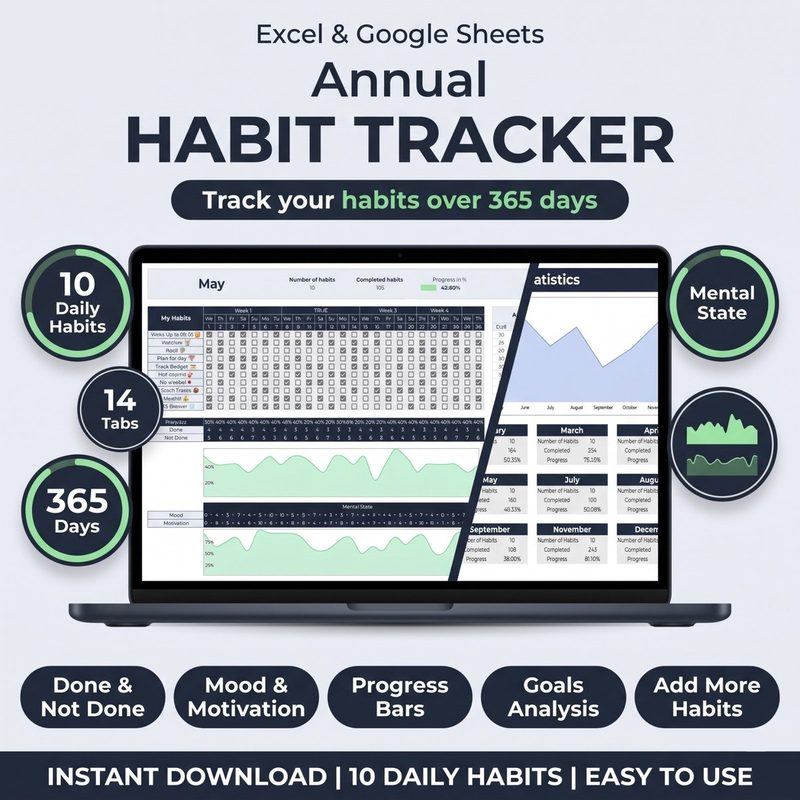
- Choose your tracker. A notebook works. A spreadsheet works better because it gives you automatic streak calculations and monthly summaries. The Habit Tracker for Excel & Google Sheets handles the math so you can focus on the behavior.
- Define your cue. Attach your new habit to an existing routine. "After I pour my morning coffee, I will stretch for 60 seconds." Your tracker records whether the stack held.
- Make the reward visible. Checking the box is itself the reward. For extra reinforcement, give yourself a small treat after tracking. The more immediate the reward, the faster the loop solidifies.
- Track consistently, not perfectly. Miss a day? Mark it and move on. The tracker is not a judge; it is a data collection tool. What matters is the long-term trend.
Ready to put the science to work?
The Habit Tracker for Excel & Google Sheets gives you automated streak tracking, monthly dashboards, and progress visualizations:everything you need to make habits automatic.
Get the Habit Tracker · $10Why This Works Long-Term
The most common objection is, "It's just a checkbox:how can that matter?" The answer is that the checkbox is the bridge between intention and identity. Every checkmark is a vote for the person you want to become.
Over time, the habit loop rewires itself. The cue triggers the routine automatically. The reward:that satisfying click of the checkbox:fires reliably. One day you realize you are doing the habit without thinking. You have built a new neural circuit.
And this is the secret most advice columns miss: keep tracking anyway. Because life happens. You get sick, you travel, you fall out of rhythm. When that happens, your tracker is the fastest way to rebuild. It re-lights the cue-routine-reward loop in days instead of months.
The science of habit formation is not complicated. Your brain runs on loops. Those loops respond to feedback. Tracking delivers that feedback with surgical precision. Use it, and you are not just hoping to change:you are engineering the change.
Further reading: Try our habit tracker Excel template to apply these principles, or check out our guide on Habit Stacking: The Secret to Building Routines That Last and the Best Free Habit Tracker Templates for 2026.