You have tried building new habits before. You set the intention, bought the gear, maybe even stuck with it for a week or two. Then life got busy, motivation faded, and the habit quietly disappeared.
You are not lazy. You are not undisciplined. You are missing a trigger.
Every habit you already have:brushing your teeth, checking your phone, making coffee:fires automatically because it is anchored to a reliable cue. The alarm clock triggers the morning routine. The kitchen counter triggers coffee. The pillow triggers sleep. These cues are so ingrained that the behavior happens without conscious thought.
Habit stacking uses these existing triggers as hooks for new behaviors. Instead of relying on willpower or a separate reminder, you piggyback your new habit onto something you already do every day. The result: routines that feel natural, that require zero motivation, and that actually stick.
What Is Habit Stacking?
Habit stacking is a technique popularised by James Clear in Atomic Habits. The core idea is deceptively simple: you take an existing habit:something already automatic:and pair it with a small new behavior you want to adopt. The existing habit acts as the cue, the new habit becomes the routine, and the completion of both delivers the reward.
This works because your brain already runs on habit loops. Every existing behavior is already part of a cue-routine-reward cycle. By stacking a new routine onto an existing cue, you shortcut the hardest part of habit formation: building a reliable trigger from scratch.
That is the entire formula. Fill in the blanks. Commit. Repeat until automatic. The elegance is that it removes the two biggest barriers to habit change: remembering to do it and deciding to do it. The existing habit handles the remembering; the stack handles the deciding.
Why Habit Stacking Works Better Than Willpower
Most people try to build habits by relying on motivation. They tell themselves, "I will meditate every morning," without attaching it to anything specific. The next morning arrives and they have to consciously decide when, where, and how to do it. That decision burns mental energy:and on a busy morning, it is the first thing to get dropped.
Habit stacking eliminates the decision entirely. The trigger is automatic. The sequence is pre-defined. You do not ask yourself whether you feel like doing the new habit:you just do it because the existing cue fired and the stack is already in motion.
Research supports this. A study published in the European Journal of Social Psychology found that habits form fastest when behaviours are performed consistently in response to the same cue. The stronger the cue-behaviour association, the less conscious effort is required. Habit stacking deliberately engineers this association.
Think of it like a line of dominoes. Your existing habit is the first domino already standing. You place the new habit directly behind it. When the first domino falls, the second falls with it. No extra push required.
Real Examples of Habit Stacks
The formula works across every part of your day. Here are concrete examples you can adapt immediately:
After I pour my morning coffee, I will write down three things I am grateful for. The coffee ritual is already automatic. By attaching gratitude journaling to the pour, you build a reflective practice without remembering to do it.
After I sit down at my desk, I will open my habit tracker and review my top three priorities for the day. The physical act of sitting cues the review. Within two weeks this becomes the automatic start to every work session.
After I brush my teeth in the morning, I will drink a full glass of water. Brushing is non-negotiable. The water glass sitting next to the toothbrush holder is all the reminder you need.
After I finish my last work meeting of the day, I will change into workout clothes. You do not have to exercise yet:just change. Often that small action is enough to carry you into the workout itself.
After I get into bed, I will read one page of a book. One page is so small it feels trivial. But most nights that single page turns into two, then five, then a chapter. The stack starts the momentum.
After I plug my phone in to charge, I will spend two minutes reviewing what went well today. The charging cable becomes the cue for reflection. Two minutes is short enough to never skip and long enough to shift your mindset.
The pattern is the same across every example: a reliable existing habit + a tiny new behavior. The new habit must be small enough that it feels almost too easy. That is intentional. A stack only works if the new behavior is frictionless. You can always expand it later.
How to Design Your Own Habit Stacks
Building a habit stack that sticks takes more than just picking two behaviours. Follow these steps to design stacks that survive real life.
1. Audit Your Existing Habits
Spend one week writing down every automatic behaviour you do each day. The order matters. Write down: wake up, check phone, use bathroom, make coffee, brush teeth, eat breakfast, commute, open laptop, check email, and so on. These are your anchor points. The most effective stacks use anchors that are truly non-negotiable:things you do every single day without fail.
2. Choose a Tiny New Habit
The new habit in a stack should take less than two minutes to complete. Want to meditate? Stack "one breath of mindfulness" after your morning coffee. Want to exercise? Stack "put on workout shoes" after your last meeting. The two-minute rule is critical. A tiny behaviour faces almost no resistance, which means you will actually do it. Once the tiny version is automatic, you can gradually extend it.
3. Be Specific About When and Where
Vague stacks fail. "After work I will exercise" is too loose because "after work" is not a precise cue. Instead: "After I close my laptop for the final time, I will change into running shorts." The more specific the cue, the more reliable the stack. Include location and context if it helps: "After I walk into the kitchen, I will fill my water bottle" is stronger than "I will drink more water."
4. Start with One Stack at a Time
The temptation is to build a tower of five or six stacks at once. Resist it. Pick one anchor habit and one new behaviour. Run that stack for at least two weeks before adding another. Each stack needs to become automatic before you layer the next one on top. Trying to overhaul everything at once is the fastest way to overwhelm yourself back to zero.
5. Track the Stack
This is the step most people skip:and the one that makes the biggest difference. A habit stack is only useful if you know whether it actually happened. Tracking gives you that data. It also provides the dopamine reward that reinforces the loop.
Open a tracker at the same point in your stack. For example: after you complete the new habit, immediately check it off. That act of checking becomes a reward that strengthens the entire sequence. Over time, your brain starts to associate the anchor cue with both the behaviour and the satisfying click of the checkbox.
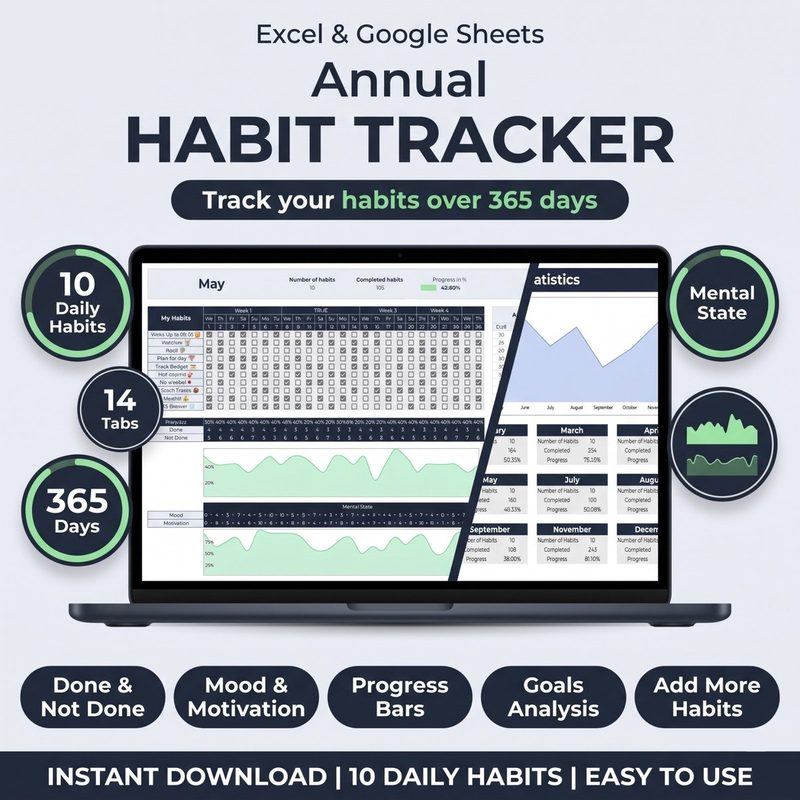
Our habit tracker Excel template is built for exactly this workflow. Each row represents a habit; each column represents a day. You can group related stacks, track streaks, and review at a glance whether your stacks are holding. The visual feedback of a full row of checkmarks is itself a powerful motivator to keep the chain unbroken.
How to Track Stacked Habits Effectively
Tracking habit stacks requires a slightly different approach than tracking standalone habits. Because stacks are sequences, you need to track both the anchor and the new behaviour:at least in the beginning.
Here is a simple system that works:
- Track the stack as a single entry. Instead of two separate checkboxes for "coffee" and "gratitude," create one entry: "Morning Stack (coffee → gratitude)." If you do both, check it once. This reduces friction and reinforces the pairing.
- Use a notes column for context. When a stack breaks, note why. "Slept in" or "Traveling" or "Forgot to charge phone" are valuable data points that tell you whether the anchor or the new behaviour needs adjustment.
- Review weekly, not daily. Daily tracking builds the habit. Weekly review builds the system. Every Sunday, look at your completed stacks and ask: which stacks fired reliably? Which ones dropped? What was the pattern? Use that insight to refine.
- Celebrate streaks. A seven-day streak of a completed stack is a milestone worth acknowledging. The Habit Tracker template automatically calculates streaks so you can see your progress without manual counting.
Tracking also solves the most common failure mode of habit stacking: the broken chain. When life interrupts your anchor habit, the entire stack collapses. If you normally stack after your morning coffee and one morning you skip coffee, the whole sequence disappears. A tracker helps you see these gaps clearly so you can build a contingency stack:a secondary version of the stack that fires from a different anchor on days when the primary anchor is disrupted.
"Habit stacking is not about adding more to your day. It is about plugging new behaviours into slots your brain has already carved out."
Common Mistakes and How to Fix Them
Even with a solid stack, things go wrong. Here are the most common pitfalls and how to course-correct.
The Stack Is Too Big
If your new habit takes more than two minutes, it is too large for a stack. Break it down. "Meditate for 20 minutes" becomes "Sit on meditation cushion." The rest follows naturally. If it does not, your stack is still working:it just needs a smaller first step.
The Anchor Is Unreliable
Some habits are not actually daily. "After I eat dinner" is unreliable if you skip dinner or eat at different times. Choose anchors that happen at the same time every day with near certainty: brushing teeth, pouring morning coffee, plugging in your phone at night, sitting down at your desk.
Too Many Stacks at Once
You have six stacks you want to build. Pick one. Run it for three weeks. Then, and only then, add a second. Trying to stack multiple habits simultaneously is like juggling while learning to ride a bike. Master one rhythm before adding another.
No Tracking
Without tracking, a stack is just an intention dressed up as a plan. You have no way to know whether it worked. You cannot see patterns. You cannot celebrate streaks. The tracker is not optional:it is the essential feedback loop that turns a stack from a good idea into an automatic behaviour.
Stack smarter, not harder.
The Habit Tracker for Excel & Google Sheets lets you design, track, and refine your habit stacks in one place. Automated streaks, monthly dashboards, and progress visualisations:everything you need to make your routines automatic.
Get the Habit Tracker · $10From Stacks to Routines
Habit stacking is more than a productivity trick. It is a way to design your day so that good behaviour happens automatically, without depending on motivation, willpower, or memory.
The real power of stacking reveals itself over time. A single stack is useful. But when you chain several stacks together:morning stack leads into breakfast stack, which leads into work-start stack, which leads into lunch stack:you have not just built a few habits. You have built a routine. And routines are what separate short-term discipline from long-term identity change.
Start with one stack today. Pour your coffee, do your tiny new habit, check it off in your tracker. Tomorrow, do it again. The day after, one more time. Before you know it, the stack is no longer a stack at all. It is just what you do.
Further reading: Learn more about the science behind habit tracking and explore our collection of free habit tracker templates.