You read the standard advice: wake at five, exercise before work, journal with your morning coffee. It sounds clean and calm and completely impossible when your shift starts at 6am on Monday, 2pm on Wednesday, and 10pm on Friday. By the weekend your body has no idea what time it is, your good intentions have evaporated, and the habit tracker you started with such optimism shows a row of empty boxes.
This is not a discipline problem. It is a design problem. Almost every popular habit method quietly assumes a stable daily rhythm, the kind of life where Tuesday looks like Monday. If your work runs on rotations, on-call blocks, split shifts, or unpredictable childcare, you need a different approach, not more willpower.
The good news is that the underlying principles of habit formation still work. You just have to change what you anchor the habit to, how you define success, and how you measure progress. In this guide you will learn the three adjustments that make routines survive an irregular week, and how to set them up in your habit tracker Excel template so the data actually reflects your life.
Why Standard Habit Advice Breaks on a Rotating Roster
Three assumptions sit underneath most habit guides. Each one fails when your schedule moves.
- Assumption one: every day has the same cue. "After my morning coffee" only works if you have a morning at a consistent hour. On a night shift, your morning coffee happens at 7pm and your body treats it as the middle of the day.
- Assumption two: a streak measures consistency. A 30 day streak is easy to protect when every day offers the same window. When half your days are 12 hour shifts, a broken streak says nothing about your commitment. It only says your roster changed.
- Assumption three: you can plan a week in advance. Shift workers often get their rota weeks ahead, but the energy cost of each shift is not visible on paper. A plan that ignores recovery days is a plan you will abandon by Thursday.
None of this means you cannot build strong habits. It means you need a tracker and a set of rules that treat variation as normal rather than as failure. That is the entire shift in thinking.
Rule 1: Anchor Habits to Events, Not Clock Times
The most useful change you can make is to stop scheduling habits at a time of day and start attaching them to an event that always happens, whatever the shift.
Instead of "walk at 7am," use "walk after I change out of my work clothes." Instead of "read at 10pm," use "read once I am in bed, before I pick up my phone." Instead of "meal prep on Sunday," use "meal prep on the day before my first early shift," which your roster tells you in advance.
Event anchors work because they travel with you. The event fires regardless of whether it happens at 5am or 11pm, and the habit rides along behind it. Good anchors for irregular schedules include:
- Arriving home from a shift. A perfect hook for a shower, a stretch, or five minutes of quiet before the household wakes up.
- Changing clothes. Work clothes off, walking shoes on. The change of state is the cue.
- Eating a meal. Any meal counts. Attach a short walk or a page of reading to the meal that follows your shift.
- Starting the car or locking the front door. These micro moments happen on every working day without exception.
- The night before a day off. Use your roster to plan the weekly tasks that need a stable block of time.
Write the anchor into your tracker as part of the habit name. "Walk after shift" is a better entry than "Walk," because it tells future you exactly when the habit is supposed to happen.
Rule 2: Give Every Habit Three Versions
On a normal schedule you might set one target: thirty minutes of exercise, five days a week. On a rotating schedule, one fixed target is either too easy on your recovery days or impossible on your long days. The fix is to define three versions of the same habit before the week starts.
The full version
This is what you do on a day with normal energy and a usable window. Forty five minutes at the gym, a proper cooked meal, a full chapter of reading. It is the version you would choose if life were predictable.
The standard version
This is the realistic default, the one you can hit on a working day without rearranging anything. Twenty minutes of movement, a prepared lunch, ten pages. Most of your week should live here, and that is a success, not a compromise.
The minimum version
This is the floor that keeps the habit alive on your hardest day. A five minute stretch, a glass of water and a piece of fruit, one page. The minimum exists so that a brutal shift never produces a zero. It is not the goal. It is the proof that the habit still exists.
Write all three versions down once, somewhere you can see them, and log which one you did each day rather than a simple yes or no. A week of four minimums and two standards is a real week of consistency, and your tracker should show it that way.
"A habit that only works on your best day is not a habit. It is a hobby with a schedule. Build the minimum version first and the rest takes care of itself."
: My Habit Journals
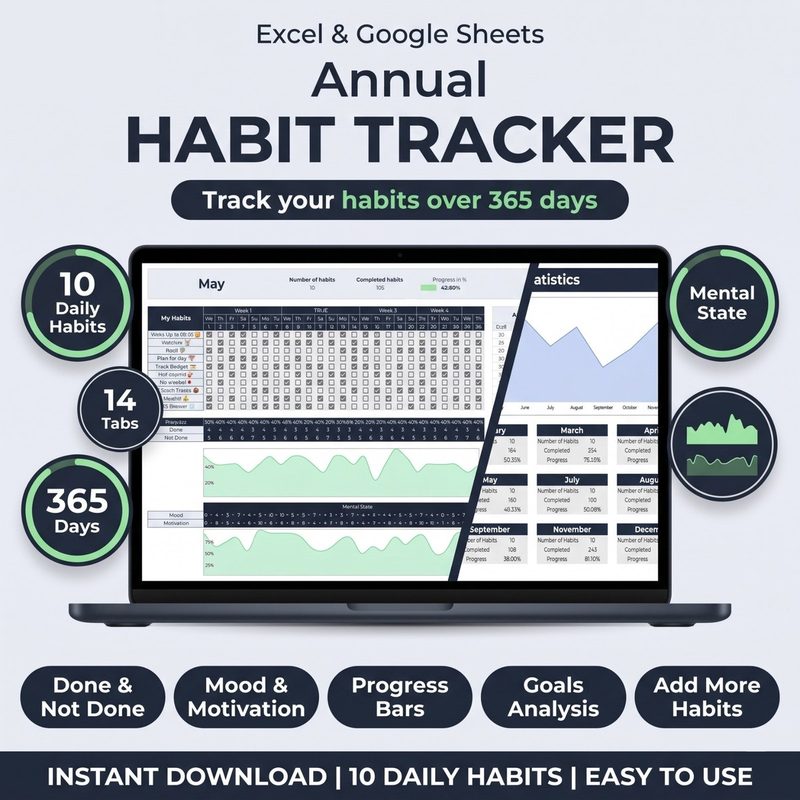
Track tiers, not just checkmarks. The Habit Tracker for Excel & Google Sheets gives you room for shift type, habit tier, and a weekly completion rate, so an irregular week still reads as progress.
Get the Habit Tracker · $10Rule 3: Measure Opportunity Rate, Not Streaks
Streaks are motivating when every day is identical. On an irregular schedule they become a source of unnecessary guilt, because the thing that broke the streak was usually the roster, not you.
Track a completion rate instead. Count the days you actually had a realistic opportunity to do the habit, then count how many of those days you did at least the minimum version. Divide the second number by the first.
If you worked five days and did the habit on four of them, your rate is 80 percent. That is a strong week, even if the two days off around it look empty on a calendar. Over a month, aim for something in the 70 to 85 percent range. Chasing 100 percent on a rotating roster is how people quit in week three.
This single change removes most of the emotional weight from tracking. Missing a day because you slept after a night shift is not a failure, it is a day without an opportunity. Missing a day you could easily have done it is different, and the rate will show you that pattern honestly.
How to Set Up the Tracker for an Irregular Week
You do not need a complicated spreadsheet. You need a layout that remembers context. Here is a structure that works in both Excel and Google Sheets, and it fits inside a standard monthly tab in your habit tracker Excel template.
Columns that carry context
- Date. The actual calendar date, not a weekday label. Weekday labels assume a Monday to Friday life.
- Shift type. Early, Late, Night, Off, or On call. A short dropdown keeps this fast to enter.
- Sleep window. The hours you actually slept, for example 23:00 to 06:30. This one column explains more about your week than any other.
- Habit columns. One per habit, with entries of Full, Standard, Minimum, or blank.
- Notes. One line maximum. "Double shift, back pain, skipped the walk" is enough.
Formulas that do the counting
If your habit entries for the week sit in cells D5 to J5, a completion rate formula looks like this:
=COUNTIF(D5:J5,"Full")+COUNTIF(D5:J5,"Standard")+COUNTIF(D5:J5,"Minimum")
Divide that by the number of cells that are not blank to get your percentage:
=(COUNTIF(D5:J5,"Full")+COUNTIF(D5:J5,"Standard")+COUNTIF(D5:J5,"Minimum"))/COUNTA(D5:J5)
Format the result as a percentage and you have a weekly score that survives a chaotic roster. If you want to separate the tiers, a simple COUNTIF for each one tells you whether you are living on minimums or spending most days at standard.
Conditional formatting that reads at a glance
Color code the tier words so the week is visible without reading every cell. Green for Full, a neutral accent for Standard, amber for Minimum. Keep blank cells genuinely blank rather than filling them with a zero, because a blank is a day without an opportunity and a zero is a false accusation.
Add one more rule: highlight any row where the shift type is Night in a distinct shade. After a month you will see the pattern clearly, usually that your habit rate dips for two days after every run of nights, which is information you can plan around.
Protect Sleep Before You Optimize Anything Else
If you only have energy to track one thing on an irregular schedule, track sleep. Sleep is the habit that determines whether every other habit is possible. A short sleep window after a late finish predicts a skipped workout far more reliably than a lack of motivation does.
Two practical rules help more than any supplement. First, keep the sleep window as consistent as your roster allows, even when the clock times move. Going to bed within a narrow band after each shift type gives your body a rhythm it can predict.
Second, treat the first day after a run of nights as a recovery day on purpose. Do not schedule appointments, ambitious workouts, or big household projects on it. Write "recovery" in your tracker the same way you would write a shift. A planned rest day is part of the plan. An unplanned collapse feels like failure, even though the two look identical on a calendar.
Mistakes That Sink Routines on Shift Work
Planning seven identical days. If your week has three different shift types, your plan needs three different shapes. Build the plan around the roster you actually have, not the one you wish you had.
Using a weekday based tracker. A grid labeled Monday to Sunday forces your life into a shape it does not have. Use dates instead, and let the rows follow the real calendar.
Treating a minimum day as a wasted day. The minimum exists precisely for the days when the full version is unreasonable. Logging it honestly is what keeps the habit from disappearing during a heavy rotation.
Reviewing only on Sundays. If Sunday is your only day off in a fortnight, the review will get skipped. Pick the review day from your roster each month, and keep the review itself to ten minutes. The weekly review process works on any day of the week.
Changing the whole plan after one bad week. One rough rotation is noise. Three rough rotations in a row is a signal. Give a new setup at least a month before you judge it, which is the same advice that applies to any 30 day habit challenge.
Frequently Asked Questions
Can I still use a streak if my schedule changes?
You can, but define the streak around opportunities rather than calendar days. For example, count consecutive shifts where you hit at least the minimum version. That keeps the motivational pull of a streak without punishing you for a rest day that the roster imposed.
What counts as a real opportunity to do the habit?
A day where you had a usable window and reasonable energy. If you slept six hours after a night shift and went straight back in, that day had no opportunity. Be honest but not generous with yourself. If you had two free hours and chose the phone, that was an opportunity.
How many habits should I track while working shifts?
Start with two. Sleep and one movement habit cover most of the benefit, and they reinforce each other. Add a third only after the first two have held for a month. A tracker with eight columns and no entries helps nobody.
Does this work for freelancers and parents too?
Yes. Anyone whose days vary in shape benefits from event anchors, tiered versions, and completion rate. The shift labels change, but the logic is identical, which is why the same habit tracker template works across both Excel and Google Sheets without modification.
What should I do when a whole week goes badly?
Do not restart from zero and do not add new rules. Open the tracker, look at which shift type had the lowest rate, and change one thing about that day only. Small targeted adjustments survive. Complete overhauls rarely do.
The Bottom Line
An irregular schedule is not a character flaw and it is not a reason to give up on routines. It is a design constraint, and constraints are solvable. Anchor your habits to events that happen on every shift. Define a minimum version so a hard day never produces a zero. Measure your completion rate across real opportunities instead of protecting a streak that the roster will break anyway.
Then put all of it in one place you can see. A tracker that records shift type, sleep, and habit tier turns a messy month into a pattern you can actually learn from. You stop guessing why Tuesdays fall apart and start seeing the answer in the rows.
Start with one habit and one week. Log the shift, log the tier, and let the percentage tell you the truth. That is how consistency gets built when nothing about your week stays the same.