A 30-day habit challenge has one thing that most attempts at change do not: a finish line. Instead of committing to "exercise more" forever, you commit to thirty checkboxes. That small shift changes everything. The goal stops being abstract and becomes countable, and anything countable can be tracked.
You have probably heard that it takes 21 days to form a habit. The number comes from a 1960s plastic surgeon who noticed his patients adapted to their new faces in about three weeks. Later research told a more honest story: automaticity usually arrives somewhere between 18 and 254 days, with the average landing around 66. So does that mean the 30-day challenge is a scam? Not at all. Thirty days is not enough to make a habit fully automatic for everyone, but it is enough to do something arguably more important: prove to yourself that you can do the thing, and collect the data that makes the habit worth keeping.
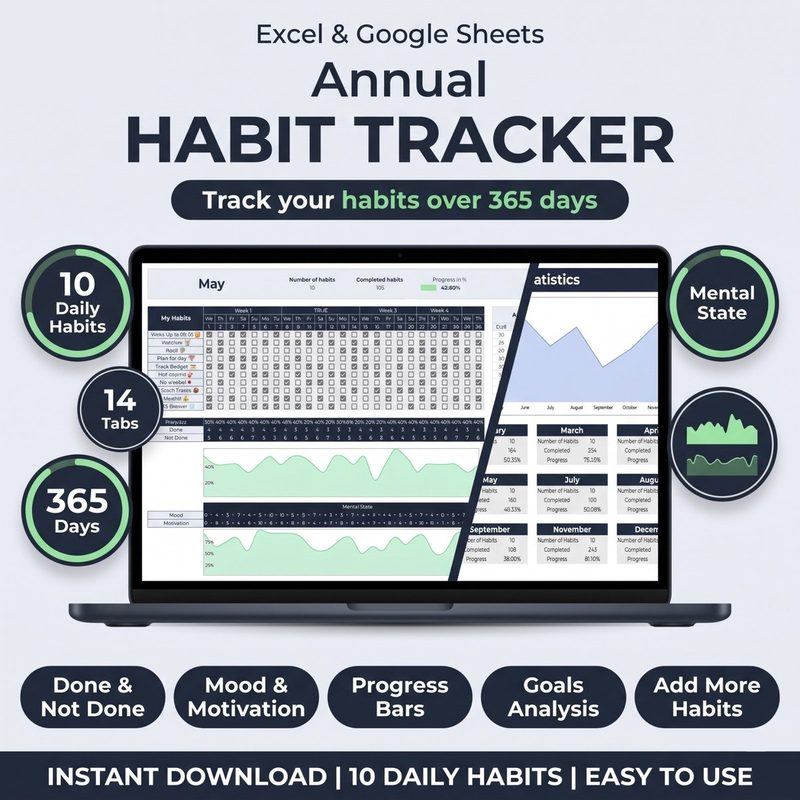
Your habit tracker Excel template is the ideal home for the challenge. It gives you a monthly grid of checkboxes, automatic streak counts, and a dashboard that shows your completion rate at a glance. This guide covers why the 30-day format works, how to set the challenge up in the template, the rules that separate finishers from quitters, and exactly what to do on day 31.
Why the 30-Day Format Works
Every habit attempt is really a negotiation with yourself. "I will read more" sounds great in theory, but it has no definition of done, no deadline, and no way to measure progress. A 30-day challenge removes all three problems at once.
- It is finite. Thirty days is long enough to see real change and short enough to stay motivated. When the end is visible, the middle is easier to survive. "I only have to do this for three more weeks" is a sentence that has carried a lot of people through day 14.
- It has a clear win condition. You either completed the thirty days or you did not. There is no gray area, which means there is no room for the self-negotiation that kills vague goals.
- It produces data. Thirty days of checkboxes gives you a completion rate, a streak history, and a honest picture of when you succeed and when you slip. That data is what makes tracking such a powerful tool: you stop guessing about your habits and start reading them.
- It builds momentum through streaks. Once you have a seven-day streak going, the thought of breaking it starts to feel worse than the effort of the habit itself. Your tracker's automatic streak count turns that psychology into a visible number you will not want to reset.
The science article on our blog explains in detail why the simple act of checking a box improves follow-through. The 30-day challenge is that effect, concentrated into a single month.
How to Set Up Your Challenge in a Habit Tracker Excel Template
Setup takes about fifteen minutes, and it is where most challenges are won or lost. A sloppy setup produces a sloppy month. Here is the exact sequence, with the part of the template that handles each step.
| Setup Step | What You Do | Tracker Feature |
|---|---|---|
| 1. Choose | Pick exactly one habit and give it a row | Habit list |
| 2. Define | Write down exactly what counts as done | Notes column |
| 3. Schedule | Set the 30-day window and an anchor time | Monthly grid |
| 4. Track | Check the box every day, no exceptions | Daily checkboxes |
| 5. Review | Check your completion rate every week | Dashboard |
Step 1: Choose One Habit
One habit per challenge. Not two, not three. The 30-day format works because it concentrates your attention, and attention is a finite resource. If you really want to change multiple things, run the challenges back to back, or track the others on maintenance while the challenge habit gets top billing. The template supports many habits at once, but the challenge should protect only one.
Step 2: Define What Counts as Done
Write your definition of done in the notes column before day 1, because a vague habit is a negotiable habit. "Exercise" is not a definition. "Twenty minutes of movement, any kind, before noon" is a definition. "Read" is not a definition. "Ten pages of a real book" is. When the definition is written down, the checkbox becomes objective: you either met the bar or you did not.
If you are unsure where to set the bar, use the two-minute rule: start so small that skipping feels stupid. You can always raise the bar in week three.
Step 3: Schedule the Window and the Anchor
Pick your start date and mark the 30-day window on the monthly grid. Then give the habit a specific time and place, what research calls an implementation intention. "I will do my ten pages at 9:00 pm in the armchair after the dishes are done" beats "I will read sometime today" every single time. For a deeper look at choosing the right cue, read our guide on habit triggers and implementation intentions.
The Five Rules That Separate Finishers from Quitters
Across thousands of challenges, the same five rules separate the people who reach day 30 from the people who quietly stop on day 12. Write them into your tracker's notes column if you need to. They matter more than the habit itself.
- Never miss twice. Missing once is an accident. Missing twice is the start of a new habit: the habit of not doing the habit. The moment you miss a day, treat the next day as the most important day of the challenge. This is the core of the broken streak recovery playbook.
- Define done before day 1. Already covered above, but it deserves a place on the list. A challenge with a written definition of done is a challenge with a referee. Without one, you are the referee, and you will always rule in your own favor.
- Never change the rules mid-challenge. Do not lower the bar on day 9 because you are tired, and do not raise it on day 21 because you feel great. The whole point is a consistent month of data. Change the rules on day 31, when the challenge is over, using the data you collected.
- Log every day, including the misses. A blank cell hides information. A marked miss shows you exactly which days are dangerous, which is precisely the information you need. Your tracker should show the misses proudly, because they are the most useful cells in the grid.
- Protect the streak. Once the streak number gets interesting, it does the motivating for you. If a day goes sideways, do the smallest possible version of the habit rather than nothing. The streak stays alive, and the identity stays intact.
"A 30-day challenge is not about proving you are disciplined. It is about proving to yourself that you can keep a promise, one checkbox at a time."
: My Habit Journals
The Week-by-Week Roadmap
The 30 days are not a flat line. They have a shape, and knowing the shape in advance is a huge advantage. Here is what to expect, week by week, and what to do in each phase.
| Week | What to Expect | Your Move |
|---|---|---|
| Week 1 | High motivation, easy wins | Keep the habit small. Bank the streak. |
| Week 2 | Motivation dips, excuses appear | Shrink the habit. Never miss twice. |
| Week 3 | First automatic days | Notice the ease. Consider raising the bar. |
| Week 4 | Identity shift | Plan day 31 before it arrives. |
Week 1: The Honeymoon
Motivation is high, the checkbox is satisfying, and the challenge feels easy. This is the danger zone in disguise: people overcommit in week 1 because everything feels great. Resist it. Keep the habit exactly as small as you defined it. The goal of week 1 is not progress, it is a streak.
Week 2: The Wall
Motivation fades, and your brain starts filing creative excuses. "I will do it tonight instead." "Weekends do not count." "I already did it three times this week." This is where the never-miss-twice rule earns its keep. If you slip, mark it honestly and make the very next day non-negotiable. Most people quit in week 2, so surviving it puts you ahead of the crowd.
Week 3: The First Automatic Days
Sometime in week 3 you will catch yourself doing the habit without thinking about it, and that is the moment the challenge starts paying off. If the habit has become genuinely easy, this is the week to gently raise the bar: ten pages becomes twenty, twenty minutes becomes thirty. The template's completion rate will show you whether the increase is sustainable.
Week 4: The Identity Shift
By week 4 you are no longer "someone trying to read more". You are someone who reads. That shift is the real prize, and it is exactly what habit tracking builds over time. Use the final week to plan what happens on day 31, because an unplanned ending is how challenges evaporate.
How to Track the Challenge
Tracking during the challenge is simple by design: check the box, keep the streak, review the numbers once a week.
- Check the box daily. Same time every day, right after the habit. The pairing of action and checkbox is what trains the loop.
- Review weekly, not daily. Looking at your completion rate every day is noise. Once a week, take five minutes to read the dashboard, the way the weekly review teaches. Which days are weak? Is the trend up or down?
- Use the notes column. One line per day is enough: what time you did it, how it felt, what got in the way. After 30 days, those notes are a goldmine of insight about your own patterns.
Start your 30-day habit challenge the right way. The Habit Tracker for Excel & Google Sheets gives you the monthly grid, automatic streaks, and progress dashboard you need to run the challenge and see the data clearly. One template, one month, one habit. Get it today.
Get the Habit Tracker · $10What to Do on Day 31
The challenge ends, but the decision does not make itself. Day 31 is when you turn the month of data into a plan, and this is where most people drop the ball. They hit day 30, feel proud, and then simply stop, which undoes most of the work. Here is the three-step day 31 protocol.
Step 1: Read the data. Open the dashboard and look at your completion rate. Above 80 percent means the habit fit your life. Between 50 and 80 means the habit was right but the bar was too high. Below 50 means either the habit or the definition needs a rethink. The numbers decide, not your mood. The monthly habit audit walks through this analysis in detail.
Step 2: Choose keep, modify, or drop. Keep the habit exactly as is if the data is strong. Modify the definition if the data is mixed: shrink it, move the anchor time, change the trigger. Drop it if the data is weak and you discovered you do not actually care about it. Dropping a habit you do not want is a win, not a failure. It frees up attention for something real.
Step 3: Chain the next challenge. The best way to make the new habit permanent is to keep it on maintenance and start a second 30-day challenge for the next habit. This is where habit stacking shines: pair the new habit with an existing routine so it has a permanent anchor, then run the next challenge. A year of back-to-back 30-day challenges is twelve new habits. That is a different person.
Common Mistakes That Kill 30-Day Challenges
Mistake 1: Running multiple challenges at once. Two challenges means two streaks to protect, two definitions to remember, and twice the negotiation. The format works because it is narrow. One habit. Thirty days. Everything else can wait.
Mistake 2: All-or-nothing thinking. "I missed Tuesday, the challenge is ruined." No. The challenge is a month of data, and one miss is a data point. Mark it, protect the next day, and keep going. Perfection is not the goal; completion is.
Mistake 3: No plan for day 31. Challenges that end in a void get forgotten. Decide in advance what happens after day 30, and write that decision into the tracker in week 4. The ending is part of the challenge.
Mistake 4: Changing the rules mid-month. Every rule change corrupts the data and opens the door to more changes. Set the definition once, on day 1, and treat it as fixed until day 31.
Mistake 5: Ignoring the misses. If you hide your misses, the tracker becomes a highlight reel instead of a tool. The misses are where the learning lives. Log them, review them, and let them shape next month's definition.
Frequently Asked Questions
Is it 21 days or 30 days to form a habit?
Neither number is a guarantee. Research suggests automaticity typically arrives between 18 and 254 days, averaging around 66. The 30-day challenge is not a magic duration, it is a well-designed experiment: long enough to generate real data and a real identity shift, short enough to stay motivated. If the habit matters to you, keep going past day 30; the challenge is the proof of concept, not the end of the road.
Can I track more than one habit during the challenge?
You can, because the template supports unlimited habits, but you should not. The challenge format works by concentrating attention on one thing. Track other habits on maintenance if you must, but give the challenge habit the protected top spot, and never let a second challenge run at the same time.
What if I miss a day?
Mark the miss honestly and make the next day the most important day of the challenge. One miss is an accident; two in a row is the beginning of a new, unwanted habit. This is the never-miss-twice rule, and it is the single best insurance policy a challenge can have. For a full recovery playbook, see our article on recovering from a broken habit streak.
Do weekends count?
Yes. A 30-day challenge means thirty consecutive days, and weekends are where habits actually live or die. If you want a different structure, define it on day 1: for example, "30 sessions over 6 weeks" for gym habits. The rule is to decide in advance and then never change it mid-challenge.
What happens after day 30?
You run the day 31 protocol: read the data, choose keep, modify, or drop, and chain the next challenge if you are keeping the habit. The template keeps all your history, so the habit you keep stays tracked forever, streaks and all, and the next challenge starts on a fresh grid.
The Bottom Line
The 30-day habit challenge is not about willpower, and it is not about the 21-day myth. It is about giving change a shape: a start date, a definition of done, thirty checkboxes, and a finish line. When a goal has that shape, your brain stops negotiating and starts executing.
Set it up in your habit tracker Excel template in fifteen minutes. One habit, one definition, one anchor time, one checkbox per day. Survive week 2 with the never-miss-twice rule, review the numbers every Sunday, and walk into day 31 with data instead of guesswork. Thirty days from now, you will either have a new habit or a very clear answer about why not. Both are progress.
Pick the habit, mark the start date, and let the checkboxes do the rest. In thirty days, you will be someone who kept a promise to themselves.
Your 30 days start today. The Habit Tracker for Excel & Google Sheets gives you automatic streaks, a progress dashboard, and a monthly grid built exactly for a 30-day challenge. Customizable columns, lifetime access, one price. Start your challenge now.
Get the Habit Tracker · $10