You know the pattern. January 1st, full of energy, you decide to run five kilometers every morning, read fifty pages a night, and meditate for twenty minutes. February 1st, you are doing none of it. The goal was not wrong. The size of the first step was.
Big habits fail not because you lack discipline but because the starting line is too far away. When a habit requires a big time commitment, a big energy cost, and a big motivational push, your brain quietly files it under "too costly" and skips it. The fix is almost embarrassingly simple: make the habit so small that saying no feels more effort than saying yes.
That is the 2-minute rule. Shrink every habit until it takes less than two minutes to complete, then track it daily in your habit tracker Excel template until the identity behind it is solid. This guide shows you exactly how, with a step-by-step setup you can copy into your tracker today.
Why Starting Small Beats Starting Strong
Most people believe motivation comes first and action follows. Research on behavior change suggests the opposite: action comes first, and motivation is the reward. Every time you complete a habit, however small, you send your brain a signal that says "this is who I am now." One two-minute workout is not a workout routine, but it is the evidence a runner would collect. Fifty of them in a row is an identity.
There are three mechanical reasons tiny habits outperform big resolutions:
- They bypass motivation. A two-minute task requires almost no willpower to start. You do not need to psych yourself up, you just do it. The decision cost drops to nearly zero, and zero-cost actions get taken.
- They build streaks. Consistency is what forms habits, and small habits are the easiest thing in the world to repeat. A 40-day streak of two-minute workouts creates more behavioral change than four heroic workouts spread across the same month.
- They defeat the "all or nothing" trap. When your habit is huge, one missed day feels like total failure and you quit. When your habit is tiny, you have no excuse to miss, so the streak survives bad days, busy days, and sick days.
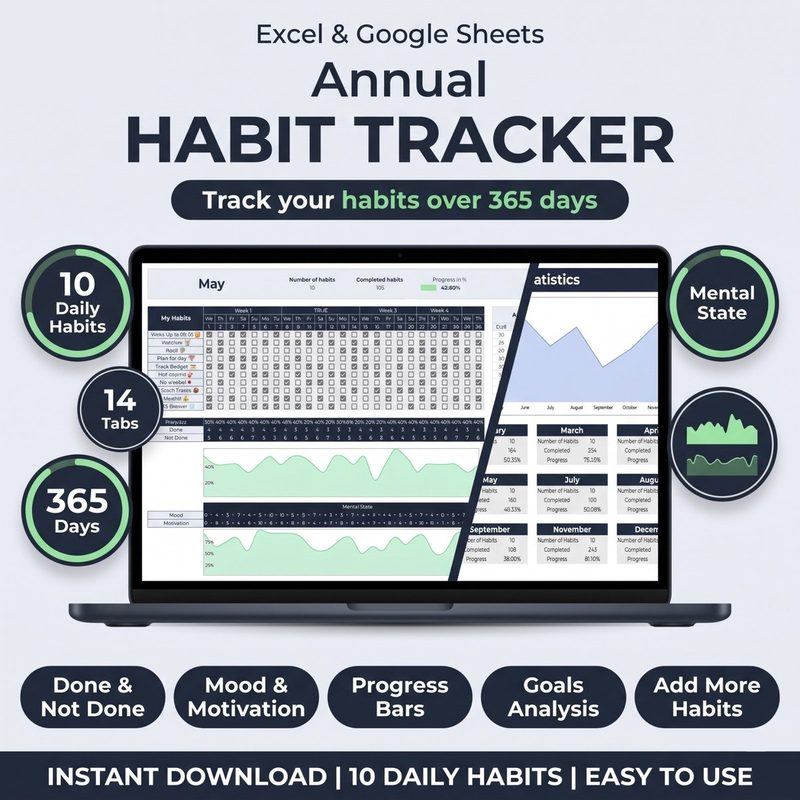
Your habit tracker Excel template amplifies all three. The monthly grid makes streaks visible, the dashboard turns raw checkmarks into completion percentages, and the simple act of logging a tiny win each day reinforces the identity you are building.
What Exactly Is the 2-Minute Rule?
The rule is simple: when you start a new habit, it should take less than two minutes to do. The point is not that two minutes is the forever size. The point is that two minutes is the doorway. You are not trying to achieve the habit in two minutes, you are trying to master the art of showing up.
Here is how common goals shrink down:
| Big Goal | 2-Minute Version | The Real Purpose |
|---|---|---|
| Run 5 km every morning | Put on running shoes and step outside | Master "runner who shows up" |
| Read 50 pages a night | Read one page | Master "reader who opens the book" |
| Meditate 20 minutes | Sit and take three breaths | Master "person who sits down" |
| Write 1,000 words a day | Write one sentence | Master "writer who starts a draft" |
| Study for 2 hours | Open the notes and read one line | Master "student who opens the material" |
| Eat healthier | Add one piece of fruit to a meal | Master "person who chooses the fruit" |
Notice the pattern. The 2-minute version is not a smaller version of the goal, it is the gateway to the goal. Once you are standing outside in your shoes, the run often happens anyway. Once the book is open, the page becomes ten. The rule works because the hardest part of any habit is the first sixty seconds, so you shrink the habit down to exactly that part.
"When you start a new habit, it should take less than two minutes to do. The point is to master the art of showing up."
: My Habit Journals
Setting Up Your Habit Tracker Excel Template for Tiny Habits
Your habit tracker Excel template is built for exactly this workflow. Here is how to configure it for the 2-minute rule:
- Rename your habits to the 2-minute version. Do not track "Run 5 km". Track "Put on shoes and step outside". The name in your tracker is the commitment you are making, so make it one you cannot fail.
- Start with no more than three habits. The 2-minute rule keeps each habit tiny, but three is the ceiling for a beginner. More habits means more decisions, and decisions are where streaks go to die.
- Pick a fixed anchor time. Attach each tiny habit to an existing moment in your day, right after coffee, right after lunch, right before bed. This is the same principle behind habit stacking, and it removes the "when do I do this?" question entirely.
- Log it the moment it is done. Open the template and mark the checkbox immediately. The two seconds of logging are part of the ritual. Your streak counter and monthly grid update automatically, and that feedback loop is what keeps you coming back.
- Set the minimum bar in your head. Two minutes is the floor, not the ceiling. If you feel like doing more, do more. But the checkbox only ever asks for two minutes, so a low-energy day still counts as a win.
Start with two minutes and let the tracker do the rest. The Habit Tracker for Excel & Google Sheets gives you monthly grids, automatic streaks, and a dashboard that makes tiny wins impossible to ignore. One template, one place, everything that matters.
Get the Habit Tracker · $10How Tiny Habits Grow into Big Results
Skeptics ask the obvious question: if I only ever do two minutes, how do I ever get anywhere? The answer is that two minutes is the minimum, not the maximum, and the 2-minute rule quietly removes the upper limit too.
Here is how growth actually happens. In week one, your tiny habit takes two minutes because that is all you committed to. But humans are momentum machines. Once you are in the running shoes, the walk to the end of the street feels natural. Once the book is open, finishing the paragraph feels natural. The "just one more" effect kicks in far more often than you expect, which is why people who start with one pushup often end up doing a full set.
On the days the extra effort does not happen, you still get your checkbox. That is the genius of the rule. It grows on your good days and protects you on your bad days, and both directions serve the same goal: never break the streak.
When you are ready to scale up deliberately, follow a simple protocol. Keep the two-minute version as your floor forever. Then add a second checkbox, "bonus", that you can mark when you go beyond two minutes. Review the bonus rate in your monthly data. When your bonus rate sits above 70 percent for three weeks, raise the floor to five minutes and add a new two-minute version above it. The tracker's dashboard shows your completion rate and trends, so you scale based on data instead of enthusiasm.
Tracking Progress and Spotting Trouble Early
The monthly grid in your habit tracker Excel template is where the 2-minute rule proves itself. A row of green checkboxes is visual proof that showing up is not the problem anymore. But the grid also exposes the two failure modes that kill tiny habits:
- Gaps in the streak. If your two-minute habit is getting skipped, the habit is still too big, the anchor time is wrong, or the reminder is missing. Fix the setup before you fix your willpower.
- Completion below 80 percent. Any habit under 80 percent monthly completion is a habit that needs a smaller version or a better anchor. The 2-minute rule only works if the bar is genuinely low.
Run a quick monthly habit audit to compare completion rates across your tiny habits. The habit with the weakest streak is the one to shrink further or re-anchor. The habit with the strongest streak is the one to scale up first. Your tracker turns "I feel like I am failing" into "habit B needs a better anchor time", and that specificity is what makes progress possible.
Common Mistakes with the 2-Minute Rule
Mistake 1: Making the tiny version too big. "Write one paragraph" is not a 2-minute habit if you are a perfectionist. "Write one sentence" is. When in doubt, shrink it again. A habit you feel silly tracking is a habit sized correctly.
Mistake 2: Scaling up too fast. The rule is not "two minutes this week, thirty minutes next week". It is "two minutes forever, plus whatever naturally happens". Let the data in your tracker tell you when to raise the floor, and raise it in small steps.
Mistake 3: Tracking the big goal instead of the tiny habit. If the checkbox says "Read 50 pages" you have recreated the all-or-nothing trap. The checkbox must always say the 2-minute version. The big goal lives in your head, the tiny habit lives in the tracker.
Mistake 4: Starting five habits at once. Tiny habits are easy individually and overwhelming in bulk. Three at a time, maximum. Add the next one only when the current three feel automatic.
Mistake 5: Skipping the log on busy days. The two minutes of the habit matter, and so do the two seconds of logging. On your worst day, do the two minutes, mark the checkbox, and let the streak carry you. That is the whole point.
Frequently Asked Questions
Is two minutes really enough to build a habit?
Two minutes is enough to build the habit of showing up, which is the part most people never master. The habit itself takes two minutes, but it usually grows well beyond that on most days. What matters is that the streak never breaks, and a two-minute floor makes the streak nearly unbreakable.
When should I scale my tiny habit up?
Scale up when the tiny version feels boring and automatic, usually after three to four weeks of consistent completion above 80 percent. Raise the floor gradually, five minutes at a time, and always keep a two-minute fallback for low-energy days.
What about habits that cannot shrink to two minutes?
Every habit has a doorway. "Run a marathon" becomes "put on your shoes". "Clean the whole house" becomes "tidy one surface". "Learn a language" becomes "open the app and do one lesson". The 2-minute version is never the whole habit, it is the entry point, and every habit has one.
Do I track the two minutes or the actual time I spend?
Track completion, not duration. Your habit tracker Excel template is designed for yes-or-no daily checkboxes. Mark the checkbox if you did the 2-minute version, and optionally log extra minutes in a notes column if you want to see how often the habit grows on its own.
What if I miss a day anyway?
Missing a day is not the problem, missing two days is. The 2-minute rule makes day two nearly impossible to miss, because the excuse "I do not have two minutes" does not survive contact with reality. If you do break the streak, read up on recovering from a broken habit streak and restart the very next day.
The Bottom Line
You have probably tried the big-start approach a dozen times, and it has failed a dozen times, not because you are weak but because the first step was too large. The 2-minute rule removes that failure mode completely. Two minutes is nothing. Two minutes is always affordable. Two minutes is a checkbox you can mark on your worst day.
The habit does not stay two minutes forever. It grows the way all real habits grow, through repetition, through streaks, through the quiet identity shift that happens when you stop being someone who plans and start being someone who shows up. Your habit tracker Excel template is the witness to that shift, one green checkbox at a time.
Pick one goal that keeps failing. Shrink it until it takes two minutes. Put it in your tracker with an anchor time. Do it today, mark it, and do it again tomorrow.
Shrink the habit. Keep the streak. Let the tracker turn two minutes into an identity.
Your streak starts with two minutes. The Habit Tracker for Excel & Google Sheets makes tiny habits visible with monthly grids, automatic streaks, and a progress dashboard. Customizable columns, automatic stats, and lifetime access for one price. Start tracking today.
Get the Habit Tracker · $10