Every morning starts with a choice. You can hit snooze, scramble through the next hour, and arrive at your first commitment already behind. Or you can step into a sequence of actions that sets the tone for the entire day. The difference between these two outcomes is not willpower. It is a system.
The problem with most morning routine advice is that it assumes you are someone else. It prescribes a 5 AM wake-up, a cold plunge, an hour of meditation, and a green smoothie that takes thirty minutes to prepare. That works for the person who wrote the advice. It almost certainly does not work for you:at least not right out of the gate.
A morning routine that actually sticks is not built on grand ambitions. It is built on honest self-assessment, tiny commitments, consistent tracking, and regular adjustment. This guide walks through each of those four pillars so you can design a morning routine that survives real life.
Designing a Morning Routine That Fits Your Life
Before you decide what to do in the morning, you need to know what morning actually looks like for you. That sounds obvious, but most people skip this step. They decide they want to journal, exercise, and read every morning without asking whether their schedule, energy levels, or environment support those activities.
Start with an honest audit of your current morning. For three days, write down exactly what happens from the moment you wake up to the moment you start your first meaningful task. Do not judge it. Just observe. You will likely notice patterns: a natural window of calm before the household wakes up, a stretch of low energy right after waking, a bottleneck around getting out the door.
Use these observations to design your routine. If you have fifteen minutes between waking and needing to leave, your routine needs to fit inside that window. If your energy is low for the first twenty minutes, your routine should not demand high-intensity exercise during that period. The goal is not to imitate an ideal morning. The goal is to find a sequence of actions that aligns with your reality.
When designing the routine itself, follow three rules:
- Limit to three activities. The best morning routines are short. Pick a maximum of three things that genuinely move the needle: hydration, movement, and one mental reset. Everything else is optional.
- Order by energy demand. Place low-energy activities first (drink water, stretch, review your day) and ramp up gradually. Jumping straight into a workout when your brain is still offline sets you up to skip.
- Build in buffers. Leave a five-minute margin between each activity and your first commitment. A routine that runs up to the last minute collapses the first time something takes one minute longer than expected.
Minute 0-2: Wake up, drink a full glass of water (kept on nightstand).
Minute 2-5: Open blinds, three deep breaths at the window.
Minute 5-12: Quick mobility or light stretching.
Minute 12-15: Review your habit tracker and top priority for the day.
Notice what is absent: no phone, no email, no news. The first fifteen minutes belong to you and your body, not to the demands of the outside world. This boundary alone makes more difference than any single activity you could add.
Start Small Enough That You Cannot Fail
There is a well-known trap in habit formation: the motivation bubble. On day one, excitement is high. You wake up early, complete every item on your routine, and feel unstoppable. By day four, the excitement has faded and the routine feels like a chore. By day seven, you skip. By day ten, you stop entirely.
The antidote is to start so small that skipping feels absurd. If your ideal morning routine includes a 20-minute run, start with putting on your running shoes and stepping outside for thirty seconds. If you want to journal for ten minutes, start by writing one sentence. If you want to meditate, start with three conscious breaths.
This approach works because it separates starting from persisting. Starting is the hard part. Once you are standing in your running shoes, the motivation to run appears naturally. Once the pen is touching the page, the sentences flow. The micro-commitment gets you past the threshold, and momentum carries you the rest of the way.
Here is the crucial follow-up: do not increase the size of your habit until you have completed the micro-version for at least two consecutive weeks. The temptation to scale up early is strong because the micro-version feels too easy. But ease is the point. A routine that feels easy is a routine you will maintain. A routine that feels like effort is a routine you will eventually abandon.
Track Your Progress with a Morning Routine Habit Tracker
Designing a routine and starting small gives you a solid foundation. But without tracking, you are flying blind. You have no way to know whether your routine is actually happening, where it breaks down, or whether it is making a difference.
Tracking solves three specific problems:
- It creates accountability. A checkbox is a commitment made visible. When you see an empty box at the end of the day, it creates a mild discomfort that motivates you to fill it tomorrow. This is the mechanism behind the famous "don't break the chain" method.
- It provides data for adjustment. A tracker tells you not just whether you did your routine, but when and why you skipped. Over a week or two, patterns emerge. You might discover that you consistently miss on days you travel, or that your routine collapses when you go to bed after 11 PM. That data is gold.
- It delivers a reward. Checking a box triggers a small dopamine release. That feeling of completion reinforces the behaviour and makes it more likely you will repeat it tomorrow. Over time, the act of checking becomes part of the routine itself.
There are dozens of ways to track a morning routine. A paper calendar with X marks. A note on your phone. A spreadsheet. But the most effective trackers share three features: they are always accessible, they show progress over time, and they make it easy to spot patterns.
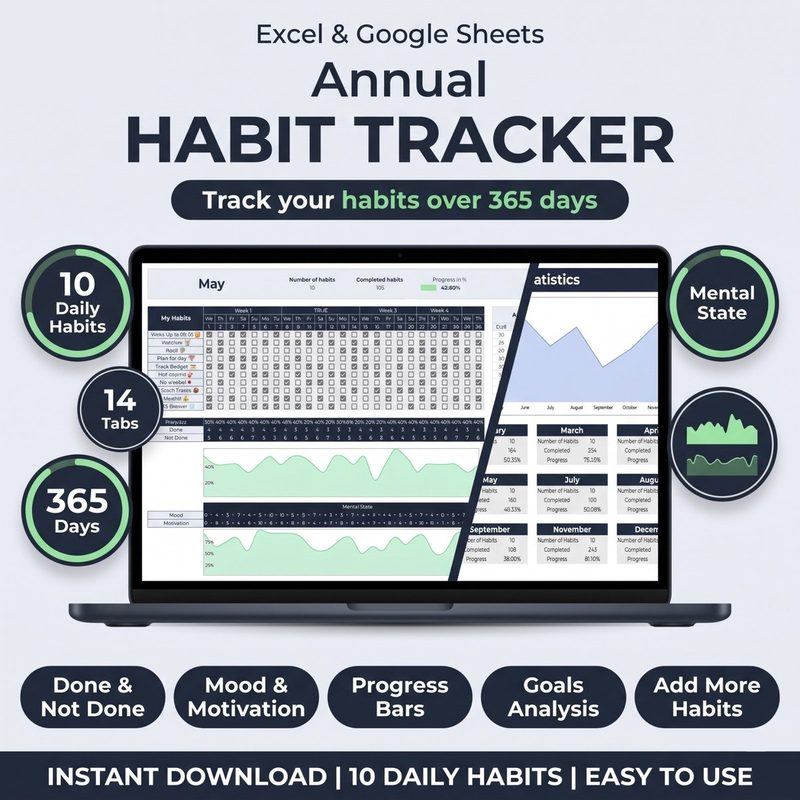
That is exactly what the Habit Tracker for Excel & Google Sheets is designed to do. Each row represents a habit:your three morning activities, for example:and each column represents a day. At a glance you can see your completed streaks, your weak spots, and your overall consistency rate. The template automatically calculates your streak length and monthly completion percentage, so you spend zero time on analysis and all your energy on execution.
For a morning routine specifically, set up your tracker like this:
- Create one row per activity. "Water," "Stretch," "Review priorities." Do not combine them into a single "morning routine" checkbox. Separate rows let you see which specific activity you skip most often.
- Add a notes column. When you skip, jot a one-word reason: "travel," "sick," "late night." After two weeks, sort by notes and look for themes. That single column will tell you more about your routine than any other data point.
- Check in the morning, not at night. The act of checking should happen immediately after you complete the activity. If you try to remember at the end of the day, you will forget or misremember. Get into the habit of logging in real time.
Ready to start tracking? Grab our habit tracker Excel template and set up your morning routine in under a minute.
Track your morning routine in seconds.
The Habit Tracker for Excel & Google Sheets gives you automated streak tracking, monthly dashboards, and visual progress reports. Includes a dedicated morning routine template with implementation intention fields. One-time purchase, lifetime updates.
Get the Habit Tracker · $10Intention Setting: The Missing Link Between Tracking and Execution
Tracking tells you what you did. But to bridge the gap between knowing what to do and actually doing it, you need one more tool: intention setting. This is the practice of pre-deciding exactly when, where, and how you will perform each morning activity before the morning arrives.
Research on implementation intentions shows that people who specify a precise time and place for a behaviour follow through at dramatically higher rates than those who merely intend to do it. A 2024 meta-analysis across 94 studies found that forming an implementation intention doubles the odds of following through on a goal. Applied to a morning routine, that means instead of telling yourself "I will stretch tomorrow morning," you say: "At 6:45 AM, after I finish my glass of water, I will do three minutes of hip stretches on the floor next to my bed."
Here is how to pair intention setting with your morning routine habit tracker:
- Write the if-then plan in your tracker's notes column. Next to each habit row, add a one-line intention: "If it is 6:45 AM and I have finished my water, then I will stretch for 3 minutes." The act of writing it down increases commitment.
- Review your intentions the night before. Spend 60 seconds before bed reviewing your morning sequence and visualising yourself executing each step. This primes your brain to recognise the cue when morning comes and reduces decision fatigue at the moment of action.
- Track intention completion separately. Add a checkbox for "Reviewed intentions last night" as a supporting habit. You will quickly notice that on mornings where you reviewed intentions, your routine completion rate is significantly higher.
The combination of tracking + intention setting creates a powerful feedback loop. Tracking reveals where you are struggling. Intention setting provides the behavioural bridge to cross that struggle. Together they transform a wish into a reliable morning system.
Adjust Based on Real Data, Not Guilt
This is the step that separates people who maintain routines for years from people who start over every January. You must adjust your routine based on what the data tells you.
Every skipped day is useful information. It is not a failure. It is a signal that something in your system needs to change. Maybe the activity is too difficult. Maybe the timing does not work. Maybe you are trying to do too many things and the routine feels like a burden instead of a gift.
Here is how to read the signals your tracker gives you:
If you track three morning activities and always skip "stretch" but reliably complete the other two, the activity itself is the problem. It might be too long, too uncomfortable, or placed at the wrong point in the sequence. Try swapping it for a different low-effort activity or reducing the duration. A two-minute stretch is better than a ten-minute stretch you skip every other day.
If your entire routine collapses on specific days of the week, the issue is environmental. You might have a standing early meeting on Tuesdays that compresses your morning window, or your weekend schedule follows a completely different rhythm. The fix is to design a light version of your routine for those days: one essential activity instead of three. Consistency over completeness.
When you review your tracker and notice a pattern of streaks ending after late nights or travel, build a contingency routine. A travel version that takes three minutes. A post-sleep-deprivation version that is just water and a single deep breath. The goal is to keep the chain alive even on the worst days.
The most important adjustment you can make is to kill a habit that is not working. Do not hold onto an activity because it looks good on paper or because someone else swears by it. If your data shows that you consistently skip journaling, remove it from your routine. Replace it with something you will actually do. The routine belongs to you, not to a productivity guru.
"A morning routine is not a test of character. It is a feedback loop. Design it, do it, track it, adjust it. The version you maintain is the version that matters."
From Routine to Identity
When you repeat a sequence of small actions every morning, something shifts. You stop being someone who is trying to establish a morning routine and become someone who has a morning routine. The identity change is subtle at first, but it is the difference between a habit that requires effort and a habit that is simply part of who you are.
That identity shift does not come from the size of your routine. It does not come from waking up at an impressive hour or completing a long list of activities. It comes from consistency. A three-minute routine done every day for three months will transform your relationship with mornings more than a thirty-minute routine done for a week.
The four pillars work together in a loop: design a routine that fits your life, start small enough to guarantee success, track every single repetition, and adjust based on what the data reveals. Run that loop for ninety days and you will not recognise the person you were at the start. Not because the routine itself is powerful:but because the system behind it is.
Choose your first activity right now. Not tomorrow. Not on Monday. Keep it absurdly small. Open your habit tracker, add it as a row, and commit to checking it tomorrow morning. The first checkbox is the hardest one. After that, it is just a sequence.
Further reading: Dive into the science of habit formation: why tracking actually rewires your brain, and discover how habit stacking helps you build lasting routines without extra willpower.