Most habit advice is written for people who want to start something. Wake up earlier. Read more. Go to the gym. But some of the habits that shape your life most are the ones you are trying to stop. The evening scroll that eats an hour. The afternoon snack you do not even remember eating. The snooze button you hit on reflex.
Breaking a bad habit feels different from building a good one, which is why quitting tends to fail even when starting succeeds. You cannot simply delete a behaviour from your brain. What you can do is redirect it, and then make that redirection visible in your habit tracker Excel template so momentum works for you instead of against you.
This guide walks through a practical method: find the real trigger, build a replacement, and track both the win and the slip until the new response becomes the default.
Why Willpower Fails at Breaking Habits
A bad habit is not a character flaw. It is a loop your brain has wired to deliver a reward quickly. The cue arrives, the routine fires, the reward lands, and the loop gets reinforced. By the time you consciously notice the urge, the behaviour is often already halfway done.
Trying to beat that loop with pure resistance is like holding a door shut against a crowd: it works as long as you keep pushing, and the moment your attention drifts, the door opens. Willpower is a finite resource that drains across the day, and bad habits usually show up exactly when you are tired, stressed, bored, or hungry. That is not coincidence. It is the loop finding its moment.
The fix is not more resistance. It is a better routine to route the urge into.
"You do not break a habit by removing it. You break it by replacing the routine while keeping the cue and the reward." The core principle behind habit reversal
Step 1: Map the Loop Before You Try to Change It
You cannot redesign a habit you have not observed. Before changing anything, spend about a week noting three things every time the bad habit shows up:
- The cue. What happened immediately before? A time of day, a location, an emotion, a person, a finished task, a notification.
- The routine. What exactly did you do? Be specific. "Scrolled on my phone" is vague. "Opened Instagram while the kettle boiled" is data.
- The reward. What did you get out of it? Relief, stimulation, escape, comfort, a break, a hit of novelty.
This observation phase does two useful things. It names the real target (which is rarely the behaviour itself, but the need underneath it), and it gives you a baseline. A baseline is what makes progress measurable later. Without it, you are guessing whether anything changed.
Log this week in a simple notes column in your tracker. You are not trying to quit yet. You are gathering evidence.
Step 2: Build a Replacement, Not a Void
Here is where most quitting attempts collapse. If you remove a habit and leave an empty slot, your brain will refill it with the same behaviour, because the cue and the reward are both still active. The routine is the only part you actually control, so replace it with something that delivers a similar reward at similar speed.
The replacement must be easy, immediate, and roughly as satisfying. If the old habit gave you a two second hit of novelty, a replacement that takes twenty minutes will not compete. Match the effort and the timing first; improve it later.
When I feel the urge to open social media, instead I will pick up the book on my desk and read one page. Same hand motion, same quick break, no infinite feed.
When the 3pm slump hits, instead I will drink a full glass of cold water and step outside for two minutes. The dip is often dehydration and stale air, not hunger.
When the alarm goes off, instead I will sit up and put both feet on the floor before reaching for the phone. The phone is what pulls me back under the covers.
Not buying is not a habit you can feel. When I want to buy something online, instead I will add it to a wish list and set a reminder for seven days out. Most items lose their pull long before the reminder fires.
When I feel the kitchen pull after dinner, instead I will make a cup of herbal tea. The ritual of preparing and holding a warm drink replaces the routine without replacing the comfort.
When I get into bed, instead I will plug my phone in across the room and open a paper book. Distance removes the cue entirely for the first twenty minutes.
Step 3: Set Up Your Habit Tracker Excel Template for Quitting
Tracking a habit you are trying to keep is simple: one checkmark per day. Tracking a habit you are trying to lose needs a slightly different layout, because success is both the presence of a new behaviour and the absence of an old one. Set your tracker up with a few separate columns so both are visible.
Column 1: The Replacement Habit
This is the behaviour you are building. Check this off every day you performed the replacement when the cue appeared. This column is your positive streak, and it is the one you want to protect. Over time it becomes the habit itself.
Column 2: The Clean Day
A simple yes or no. Did the old habit stay dormant today? Many people prefer to track the clean day rather than count the slip, because it keeps attention on what you did right. A full row of clean days is a moving picture of your progress.
Column 3: Urge Wins
Log days when an urge showed up and you routed it into the replacement. This is the column that matters most early on, because urges are the actual battleground. A day with three strong urges and zero slips is a far bigger win than a day with no urges at all, and it deserves to be recorded as such.
Column 4: Trigger Notes
Free text. Note what set the urge off. After two or three weeks you will see a pattern: late nights, skipped meals, certain people, certain rooms. Patterns are what let you redesign the cue instead of fighting it forever.
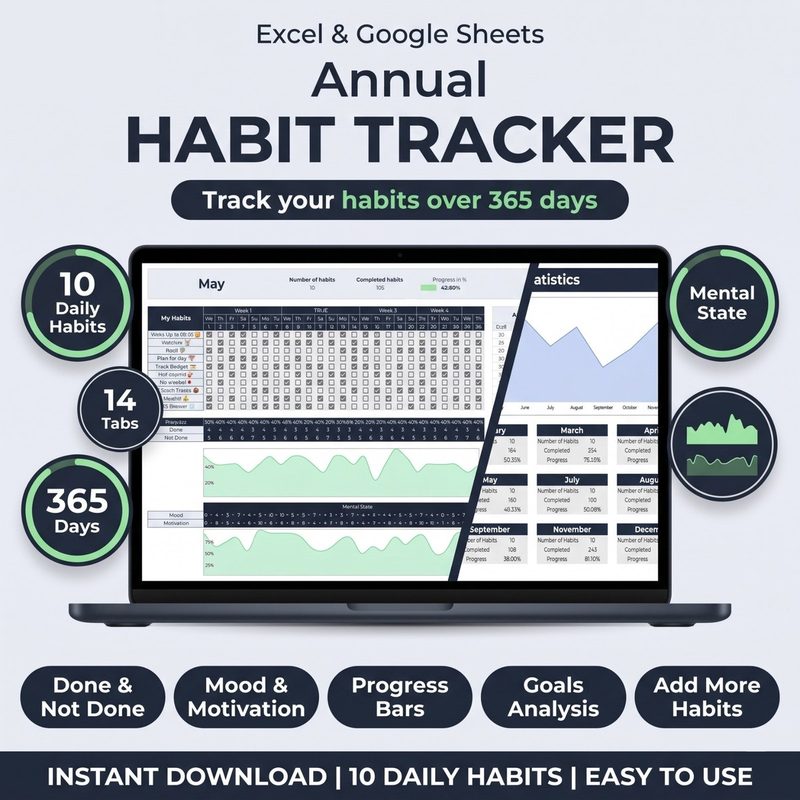
Our habit tracker for Excel and Google Sheets is built to hold all four of these columns on one clean grid, with automatic streaks so you are never counting checkmarks by hand. Group your replacement habit and your clean days side by side and the story of each week is visible at a glance.
Step 4: Handle Urges with a Delay Rule
An urge is not an instruction. It is a wave that rises, crests, and falls, usually within a handful of minutes. The goal is not to feel no urge. It is to stay on your feet until the wave passes.
Pick one delay rule and commit to it before the urge arrives, because you will not design one well in the moment:
- The ten minute rule. When the urge hits, set a timer for ten minutes and do the replacement in the meantime. Most urges do not survive the full ten minutes.
- The if-then rule. Pre-decide your response in advance: "If I want to scroll in bed, then I will read one page instead." A decision made at a calm moment needs no willpower when the moment is not calm.
- The physical break rule. Change your physical state: stand up, walk to another room, drink water. Urges are tied to context, so changing context weakens them.
Whatever rule you choose, log it as a win when it works. That checkmark is not just record keeping. It is the reward that makes the new response slightly more automatic the next time.
Step 5: Plan for Slips Before They Happen
You will slip. Nearly everyone does, especially in the first two weeks. The mistake is not the slip. The mistake is treating a slip as proof that you have failed and abandoning the whole effort.
Write down your slip rule now, while you are calm:
- One slip is not a streak reset. Mark the day honestly, note the trigger, and continue the chain the next day. If your tracker counts clean days, a single miss does not erase the previous three weeks.
- Study the slip, do not punish yourself for it. Ask what cue you missed and whether the replacement was too hard in that moment. Adjust the replacement, not your worth.
- Never miss twice. Two misses in a row is where a habit restarts. One miss is noise. Two is a pattern. Draw the line at two.
This is exactly why a tracker helps more than a mental pledge. Memory is unreliable and self critical. The grid is neither. It shows you that a rough Tuesday was one square out of thirty, not the collapse it felt like at the time. If you want a deeper dive into recovery mechanics, our guide on recovering from a broken streak covers how to get back on track without losing the ground you have gained.
Track the replacement, not just the resistance.
The Habit Tracker for Excel & Google Sheets gives you clean streaks, urge logging, and monthly dashboards in one grid so your progress is visible every single day of the quit.
Get the Habit Tracker · $10Common Mistakes When Breaking Bad Habits
Trying to Quit Everything at Once
Willpower is shared across every habit you are trying to change. Pick the single habit with the biggest impact on your day and give it your full attention for a month. Stack the next one only after the first replacement has become automatic.
Removing the Cue Instead of the Routine
You rarely can remove the cue. Stress, boredom, and bedtime will keep arriving. The routine is the controllable part, which is why the replacement method outperforms pure avoidance every time.
Measuring Only the Slips
If the only thing you record is failure, you train yourself to associate the tracker with shame and you stop opening it. Log the urge wins and the clean days with equal weight. What gets measured and celebrated gets repeated.
Expecting a Linear Line
Progress looks like a jagged graph, not a runway. Week two is often harder than week one as early novelty fades. The tracker shows the shape of the whole curve, which is why people who track are far less likely to quit on a bad day.
What to Expect in the First Month
The first week is the noisiest. Urges will be frequent and loud, and your replacement habit will feel clumsy and deliberate. Expect to be aware of every single instance. That awareness is uncomfortable but it is also proof you have stopped running on autopilot.
By week two the loudest urges have usually faded, and the ones that remain cluster around specific cues you have now identified in your notes column. This is where you redesign your environment a little: move the snack out of sight, charge the phone across the room, keep the book where the remote used to be.
By week four the replacement starts to feel less like a decision and more like a default. You will still get urges, but they arrive later and pass faster. When you look back at your tracker template, the trend will be plain: more clean days, fewer slips, and a growing column of urge wins that you can point to the next time you doubt yourself.
Start with One Replacement This Week
Pick the one habit you would most like gone. Map its cue, its routine, and its reward for a few days. Choose a replacement that matches the reward and the timing. Then open your tracker and build four columns: replacement habit, clean day, urge wins, and trigger notes.
Check one box today. That single square will not feel like much. But a tracker is not a scoreboard for who you already are. It is a set of directions for who you are becoming, and the fastest way to break an old habit is to make a new one visible enough that you would rather not break it.
Further reading: See how habit triggers and implementation intentions work and learn how tracking builds lasting discipline.