September is the season of fresh notebooks, new highlighters, and ambitious study schedules. Students everywhere open a blank calendar, block out four hours of nightly study, and genuinely believe this semester will be different. By October, most of those schedules are abandoned, and by finals week the familiar panic-cram cycle is back in full force.
Here is what separates students who consistently perform well from students who rely on last-minute heroics: they do not study more, they study more consistently. The top performers treat studying like a daily habit, not a looming event. And the most reliable way to make any habit stick is to track it.
In this guide you will learn the four study habits that actually move grades, how to configure a habit tracker Excel template for the school year, and how to read your tracking data so you can adjust before the semester slips away.
Why Study Habits Fail Without Tracking
Most study plans fail for a deceptively simple reason: studying is invisible until it is too late. You cannot see progress after one quiet evening of reading, so the effort feels wasted, and an invisible effort is easy to skip. Grades, the only feedback you get, arrive weeks after the work that produced them. By the time you see the result, the behavior that caused it is a distant memory.
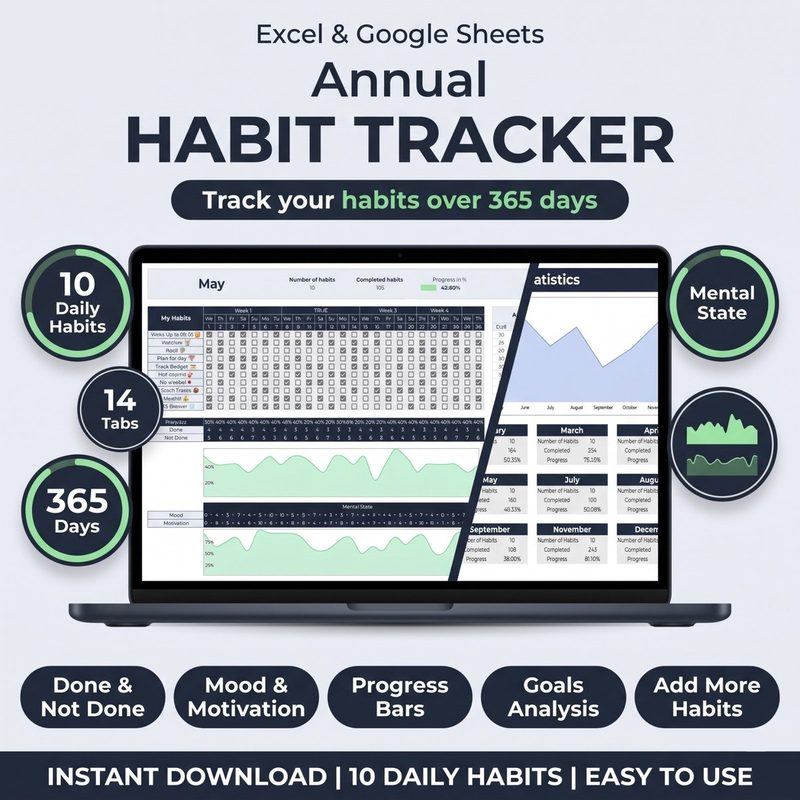
Tracking solves this by converting effort into evidence. When you check a box in your habit tracker for Excel & Google Sheets, you create a visible record of work that the syllabus will not show you for another month. Your streak becomes immediate feedback. Miss a day and you see the gap the same evening, not after the exam. This is the same feedback loop that makes habit tracking work in every other area of life, and the research backs it up: the simple act of recording a behavior dramatically increases the chance you repeat it, as we covered in the science of habit formation.
There is a second reason study plans collapse: they are built as one giant habit. "Study for four hours tonight" is not a habit, it is a marathon, and marathons require motivation you will not have on day 23. Real study routines are built from small, specific, repeatable behaviors. Here is the good news: you only need four of them.
"A grade is a lagging indicator. Your daily study habits are the leading indicators. Track the habits and the grades will take care of themselves."
: My Habit Journals
The Four Study Habits That Move Grades the Most
Before you open your tracker, decide what you are tracking. These four habits consistently separate consistent students from chronic crammers. Pick one or two to start, then add the rest over the first month.
1. The Daily Start Ritual
Every study session needs a reliable trigger. Choose a fixed cue: right after your last class, immediately after dinner, or as soon as you sit at your desk. Attach a ridiculously small first action, open your notes, write tomorrow's task list, or set a two-minute timer. This borrows directly from the 2-minute rule: starting is the hardest part, so make the start effortless. The ritual converts "I should study sometime" into a decision you already made.
2. One Protected Focus Block
Guard one block of 45 to 90 minutes per day where your phone is in another room, notifications are silenced, and studying is the only option. Consistency beats duration: a daily 60-minute block outperforms a weekly six-hour marathon because retrieval happens repeatedly instead of once. If you struggle to protect this block, our guide to building a deep work routine walks through the exact setup.
3. The Active Recall Session
Reading and highlighting feel productive but create a false sense of mastery. Active recall, closing the book and pulling information out of your own memory, is one of the most effective learning techniques ever measured. Make it a tracked habit: after each study block, spend ten minutes writing down everything you remember, answering practice questions, or explaining the topic out loud. If you cannot recall it, you did not learn it, and now you know exactly what to review tomorrow.
4. The Five-Minute Shutdown
End every session by logging what you covered and writing down tomorrow's single most important task. This tiny review habit does two things: it feeds your tracker with accurate data while the session is fresh, and it lets your brain stop worrying about forgotten tasks. Students who log their work daily never face the "what did I even do this week" panic that derails so many study plans.
How to Set Up Your Study Habits in the Tracker
Once you know your four habits, the setup takes less than ten minutes. The habit tracker Excel template is designed for exactly this, so here is how to configure it for the semester:
- Name each row after a behavior, not a goal. Use "Focus block completed" instead of "Study more", and "Active recall done" instead of "Learn biology". A checkbox needs to describe an action you can finish today.
- Use the notes column for subject and duration. Write "calculus, 50 min" in the notes field each day. After a few weeks you can see which subjects are getting real time and which are being silently starved.
- Set realistic weekly targets. If you have never tracked before, aim for four out of seven days per habit, not seven out of seven. You can raise the bar after a month of proof.
- Keep the list between three and five habits. A tracker with twelve study habits becomes a chore list, and you will abandon it by week two. The monthly dashboard in the template will show you completion rates at a glance.
- Protect your streaks but expect gaps. When a day is missed, the goal is to never miss twice. If you need the full comeback strategy, read our guide on recovering from a broken streak.
Set up your semester in minutes. The Habit Tracker for Excel & Google Sheets gives you daily checkboxes, automatic streaks, and a monthly dashboard. Rename the habits to match your courses and start tracking today.
Get the Habit Tracker · $10.00Track Focus Sessions, Not Just Hours
New trackers make a predictable mistake: they log "hours studied" and feel productive while half-watching their phone. Hours in the chair are a weak metric because an hour of distracted reading is nearly worthless. What matters is the number of focused sessions you complete.
This is where a simple checkbox outperforms a stopwatch. Define your session unit in advance, one focus block of at least 45 minutes with no phone access, and track each completed block as a single check. If you prefer shorter bursts, track completed pomodoros (25 minutes of focus followed by a 5-minute break) and make three pomodoros your daily minimum.
Why does this work? Counting completed sessions gives you a clean, honest number you can trend over weeks. When your weekly session count climbs from eight to twelve, you have objective proof the routine is working. When it drops to two, the tracker tells you before a midterm does. A simple count of focused sessions is also forgiving: a chaotic day with one good block still counts as a win, and that feeling of winning is what keeps streaks alive.
Make Review a Habit, Not an Event
The single biggest mistake in student tracking is treating review as something you do the night before an exam. Review works on a schedule, not under pressure. The research on spaced repetition is unambiguous: revisiting material after a delay, then again after a longer delay, produces dramatically better retention than massed repetition. And spaced repetition is just a habit with a calendar.
Here is how to build it into your tracker. First, the daily layer: your active recall habit (habit number three above) is your every-day review. Second, the weekly layer: add a Friday or Sunday habit called "Weekly subject review" that covers the week's material in each course. This pairs perfectly with a Sunday reset and weekly review, where you look at the week's completion rates and plan the next one while the data is still fresh.
Students who make review a logged habit walk into exams having already seen the material three or four times. Cramming becomes unnecessary, which matters because cramming is the study behavior most correlated with burnout and worst correlated with long-term retention.
A Real Example: Tracking Your Way Through the Semester
Maya, a second-year engineering student, started the fall semester with the same plan she had abandoned twice before: study every evening until the work was done. By week three she was already skipping nights and feeling guilty. Then she switched tactics. She bought the habit tracker for Excel & Google Sheets and started with just three habits: one focus block before dinner, an active recall session, and a five-minute shutdown log.
The first month: Her completion rate hovered around 60%. The tracker showed something she had never noticed: her focus blocks happened reliably on Tuesday and Thursday but collapsed on Monday, the day her hardest class ran late. She was scheduling against her energy instead of around her calendar.
The adjustment: She moved her focus block to 7:30 AM on Mondays and Wednesdays, protected it like a class, and added a "weekly subject review" habit on Sunday afternoons. She also started writing the subject in the notes column after a friend pointed out her math courses were getting twice the time of her humanities courses.
The result: By November her completion rate sat at 85%, every subject had at least two review passes before the first midterm, and she walked into finals having reviewed each course weekly for two months. No all-nighters, no panic, and her GPA improved by half a point. The studying did not get easier. The tracking just made it visible, and what is visible gets done.
Common Study Tracking Pitfalls (and the Fix for Each)
Tracking is a skill, and every student hits the same four walls. Here is how to get through them.
Pitfall: You put every course and every task in the tracker. A twelve-row tracker is a to-do list, not a habit tracker. Fix: keep only three to five behaviors per term. Courses rotate in the notes column, but the behaviors stay constant.
Pitfall: One missed day becomes a missed week. Perfectionism is the number one streak killer. The rule is simple: never miss twice. A single blank cell is information, not failure. If you are already in the spiral, the broken streak recovery guide will pull you out.
Pitfall: You measure time at the desk instead of learning. Hours logged feels productive but hides distraction. Fix: track completed focus sessions and active recall sessions. Those two numbers predict exam performance far better than hours.
Pitfall: You set the semester schedule in September and never touch it again. Course loads shift, projects land, energy changes. Fix: run a monthly habit audit where you review your completion data and adjust targets, and connect each term's habits to the goals that matter in your goal setting routine.
Make this the semester tracking finally sticks. The Habit Tracker for Excel & Google Sheets works on any laptop, phone, or tablet, so your study log is always one tap away. One-time purchase, lifetime access, and free updates.
Get the Habit Tracker · $10.00The Bottom Line
Every September, thousands of students fail because they plan their studying like a project instead of building it like a habit. Projects need motivation. Habits need repetition, and repetition needs a tracking loop to survive.
You do not need to study longer hours. You need four small habits, a habit tracker Excel template to make the work visible, and a weekly moment to read what the data is telling you. Start with one focus block a day and one active recall session. Track them honestly. Review your numbers on Sunday. Adjust and repeat.
The students who finish the semester strong are not the ones who tried hardest in December. They are the ones who showed up consistently in September, October, and November. This year, let your tracker be the reason you are one of them.