Almost everyone has bought a notebook with good intentions. Almost nobody fills it. The notebook sits on the nightstand for a week, then moves to a drawer, then disappears into a box during the next move.
The problem is rarely a lack of interest in reflection. It is that journaling is usually framed as an open-ended creative act. You sit down, face a blank page, and wait for something worth writing. Some nights that works. Most nights you are tired, the page stays blank, and the habit quietly dies.
A journaling habit survives when it behaves like any other habit: a clear cue, a small defined action, and a visible record. That last part is where most advice stops short. A habit tracker Excel template turns journaling from a vague aspiration into something you can measure, review, and adjust. This guide shows you how to set one up and what to do with the data once you have four weeks of it.
Why Most Journaling Habits Die in Week Two
Three forces kill the habit, and none of them is laziness.
- The blank page problem. Deciding what to write is a separate task from writing. When you have to solve both at once, the friction is high enough to skip.
- The all-or-nothing entry. People imagine a page of flowing prose. When they only have four minutes, they write nothing because a short entry feels like a failure.
- No feedback loop. Nothing marks the behavior as done, so the brain never gets the small closure that makes repetition easier.
Each of these has a simple fix. Prompts remove the blank page. A minimum entry length removes the all-or-nothing trap. A tracker provides the feedback loop.
The Minimum Effective Entry: Four Minutes, Three Lines
Set the bar low enough that you can clear it on your worst day. A good minimum is three lines and four minutes:
- One fact. What actually happened today. "Finished the client draft at 3 p.m."
- One thought. What you make of it. "It went faster once I turned off notifications."
- One next step. What you will do about it. "Same setup tomorrow morning."
That is a complete entry. It takes less time than brewing tea. On days when you have more to say, keep going. On days when you do not, three lines still counts, and the count is what keeps the habit alive.
"The habit is showing up to the page, not producing a masterpiece. Consistency is the product. Insight is the byproduct."
Anchor Journaling to a Cue You Already Have
New habits fail when they depend on remembering. The fix is to attach the behavior to something that already happens without fail. This is the same implementation intention approach we cover in the guide to habit triggers and implementation intentions, applied to writing.
Write the plan as a sentence with a fixed cue and a fixed action:
- "After I set my coffee mug down, I will write three lines at the kitchen table."
- "After I close my laptop for the day, I will write three lines before I stand up."
- "After I brush my teeth at night, I will write three lines before I get into bed."
Pick one. Do not add a second cue until the first one is automatic. If mornings are chaotic, the evening cue is the better bet, and the evening wind-down routine guide shows how to build a sequence around it.
What to Track in a Journaling Habit Tracker
Do not track everything. Five fields keep the daily entry under 60 seconds, which matters because a tracker that takes longer than the habit will be abandoned first.
- Wrote today: a simple yes or no, or a checked box. This drives your completion percentage.
- Minutes: a realistic number, usually between 3 and 15. Do not round up to feel productive.
- Prompt or mode: which entry type you used, such as "morning plan" or "evening review." This tells you which format you actually stick with.
- Mood before and after: a 1 to 5 rating at each point. The gap between them is the most useful number in the whole tracker.
- One word for the day: a single word that captures the tone. It makes four weeks of entries scannable in seconds.
If you want a sixth field, add a short note about where you wrote. Location data often explains more than willpower does. "Desk, 7 a.m." on the good days and "couch, phone nearby" on the bad ones is a pattern you can act on.
Setting It Up in the Excel Template
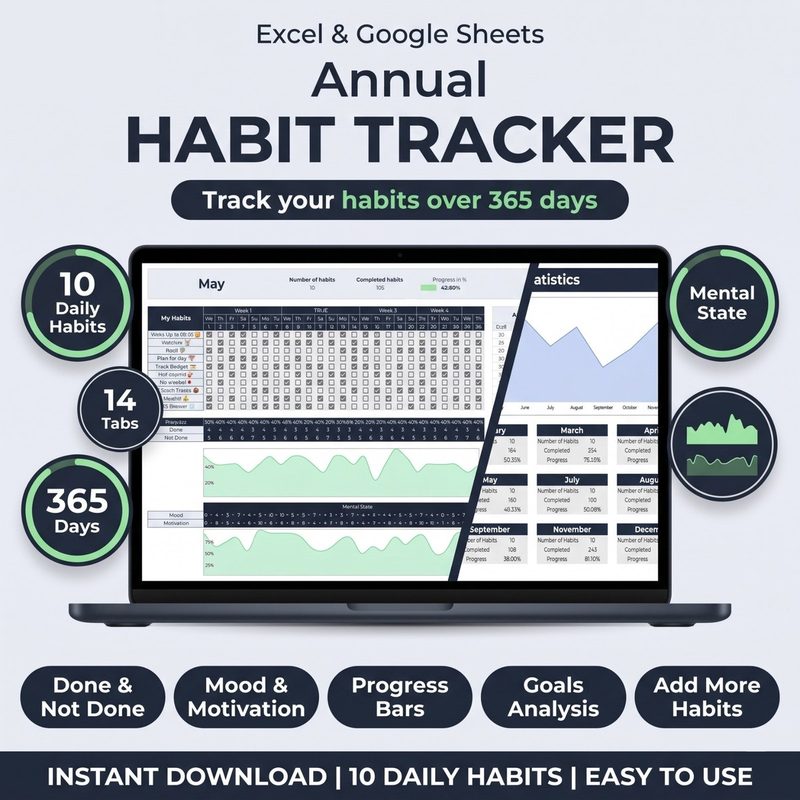
You can build this from scratch with a date column and a checkbox column, but you will spend an evening on formulas that already exist. The Habit Tracker for Excel and Google Sheets ships with a daily grid, streak counters, and a monthly dashboard. Here is how to shape it for journaling:
- Create a habit row called "Journal." Mark it complete when you write at least three lines. Length is not the measure. Showing up is.
- Add the five fields as columns to the right of the daily grid: minutes, prompt, mood before, mood after, and one word.
- Let the dashboard do the counting. Completion rate, current streak, and longest streak update from the checkboxes. You should never calculate these by hand.
- Add a weekly summary row. Total minutes and average mood shift for the week give you a two-number snapshot that is easy to compare across months.
- Set a review reminder. Ten minutes every Sunday. The Sunday reset guide gives you the questions to ask.
If you prefer to understand the mechanics before using a template, the step-by-step tutorial on how to build a habit tracker in Excel or Google Sheets covers the formulas behind streak counts and conditional formatting.
Eight Prompts That Do Not Require Inspiration
The point of a prompt is to remove a decision, not to produce deep philosophy. Keep a short list where you can see it and rotate through it without overthinking.
- What took more energy today than it should have?
- What went better than I expected, and why?
- What did I avoid today, and what was I protecting myself from?
- One thing I want to remember about today.
- What would make tomorrow easier for the version of me who wakes up at 6 a.m.?
- What did I say yes to that I should have declined?
- Who or what deserves more of my attention this week?
- What am I pretending not to know?
Number 8 is uncomfortable, which is usually a sign it is worth writing about. If a prompt produces nothing, answer it in one sentence and move on. The habit matters more than the depth of any single entry.
Rotate Three Modes of Journaling
Variety keeps the practice from feeling stale, but only if the modes are scheduled rather than chosen by mood. A simple rotation works:
- Daily micro entry (most days): three lines, four minutes, no pressure. This is the habit itself.
- Weekly review (once a week): fifteen minutes on Sunday to read the entries and look for patterns. This is where the monthly habit audit begins to take shape.
- Monthly reflection (once a month): one longer entry about what changed, what stalled, and what you will drop. One page is plenty.
Notice that only the daily entry is required. The weekly and monthly sessions exist to turn raw entries into decisions, and they are the reason the tracker is worth keeping.
What to Look For After 30 Days
Four weeks of entries is enough to see things memory would never surface. Read the data with three questions in mind.
When does the habit actually happen? Compare completion rate by time of day and location. If morning entries succeed 80 percent of the time and evening entries succeed 30 percent, you do not have a discipline problem. You have a scheduling problem, and scheduling problems are easy to fix.
Does journaling change your mood? Average the mood before and after scores. A consistent positive gap means the practice is doing real work for you. A flat or negative gap is useful information too: it may mean you are using the wrong format, such as free writing when a structured prompt would serve you better.
Which prompt do you return to? The prompt column often reveals a theme you did not know you were circling. If you keep writing about the same project or the same relationship, that is where your attention wants to go.
The science of habit formation explains why this review matters: the record is not a scorecard, it is feedback. Feedback is what turns repetition into learning.
When You Miss a Day
You will miss days. Travel, illness, a late night, a child who will not sleep. The habit is not fragile because of one gap. It is fragile when the gap becomes a story about failure.
Two rules keep a miss from becoming a stop:
- Mark it honestly. An empty box with a note is better than a backfilled entry. The data only helps if it is true.
- Never miss twice. The next scheduled cue is the recovery point. Not a perfect week, not Monday. The next one.
Our guide to recovering from a broken streak goes deeper on the psychology of the restart, including why the second miss matters more than the first.
Ready to make journaling measurable?
The Habit Tracker for Excel and Google Sheets gives you daily checkboxes, automatic streak counts, and a monthly dashboard, so you can see whether the writing habit is holding without doing any math.
Get the Habit Tracker · $10Common Questions About Journaling Habits
How long should a daily entry be?
Three lines is enough. A useful target is four minutes and three sentences: one fact, one thought, and one next step. Longer entries are optional. People who set a one-page minimum tend to quit within two weeks, while people who set a three-line minimum tend to still be writing six months later.
Morning or evening?
Whichever slot you can protect consistently. Morning entries tend to set direction, and evening entries tend to close the day and clear your head before sleep. Pick one, run it for two weeks, and compare completion rates in your habit tracker before adding the other. If you already have a morning routine, the morning routine guide shows where a short writing block fits.
Do I need a paper notebook or a spreadsheet?
Both work. Paper feels better for long entries. A spreadsheet is better for the part that keeps the habit alive: streak counts, completion percentages, and month over month comparison. Many people write on paper and log the five fields in the habit tracker template in under a minute. Use whichever combination you will actually repeat.
Further reading: Start with the habit tracker Excel template, then read how to build an evening wind-down routine, the Sunday reset and weekly review, and how to build a habit tracker from scratch.